


The Thailand office of the active environment conservation group recently released a report “Krabi at the crossroads: Dirty Coal vs. Clean Renewable Energy”, emphasizing that coal is not the answer to Thailand’s energy security.
The group has called on authorities to scrap any/all coal projects in Krabi and embrace a decentralized hybrid renewable energy system that can bring electricity and development, without jeopardizing Krabi’s economy and environment.
“Thailand is at energy crossroads. People are keeping a close eye on the country’s decision makers – will they steer Thailand towards becoming a renewable energy leader or stay on the dirty old path of fossil fuels?” asked Tara Buakamsri, Thailand Country Director for Greenpeace Southeast Asia.
“The proposed plan to build a new coal fired power plant and coal seaport in Krabi is clearly a step in the wrong direction.”
Under Thailand’s Power Development Plan (PDP 2010 Revision 3), an 870 mega-watt coal plant will be built at the location of an existing fuel oil power plant owned by the Electricity Authority of Thailand (EGAT) in Nuea Klong district of Krabi province. Currently, the coal power plant and coal seaport projects are being reviewed in an Environmental Health Impact Assessment (EHIA) process. The projects are slated for construction in 2015, and would be operational in 2019.
“The meager benefits from the proposed coal power plant would in no way compensate for the losses for Krabi’s economy, local livelihoods and tourism,” Tara added. “Krabi is not only a centre of marine biodiversity in the region, but it also provides vital livelihoods and revenue. The estimated annual use value of the Ramsar site in Krabi River Estuary is $9.7 million [B311 million] for recreation and tourism alone. This does not even include the factor of the economic value of fishing, aquaculture and agricultural related activities for the economy.”
The report launched today details how, after an inadequate Environment Health Impact Assessment (EHIA) process, the government and EGAT plan to expand coal in Krabi in spite of the area being renowned as a global marine biodiversity hotspot and a Ramsar site. In addition, the report also identifies impacts on Krabi’s local tourism as well as the local economy, the past hidden cost of coal for Krabi residents, and the failure in Environment Health Impact Assessment. More importantly, the report proposes a decentralized hybrid Renewable Energy system as a solution for Thailand’s energy future.
“Krabi is in the position to be a leader in developing a decentralized hybrid renewable energy system from its own power potential such as biomass, biogas, solar and wind,” said Asst. Prof. Dr. Jompob Waewsak, Director of Research Center in Energy and Environment, Thaksin University (Phatthalung Campus). “Thailand was among the first countries in Asia to introduce incentive policies for the generation of electricity from renewable energy (RE) sources. Programmes for small and very small power producers created predictable conditions for RE investors to sell electricity to the grid. This is a good start to expand investments in renewable energy, and should be pursued by the government.”
Greenpeace believes that, instead of constructing a coal plant, a decentralized hybrid renewable energy system is the solution for Krabi, supplemented by a rural and community-based development approach. The group says this is a win-win solution for the climate, local job creation, empowerment of communities, and people facing energy poverty, and gives Thai businesses a chance to grow.
Greenpeace has urged EGAT and the government to stop pursuing the ill-advised and destructive coal project, to preserve Thailand’s fragile wetlands and the rich marine environment, and to fully implement its energy efficiency development plan (2011-2030) and alternative energy development plan (2012-2021).
To learn more about the reasons why the coal seaport and power plant are being developed, i.e. Southern Thailand's energy demands, read this related story.
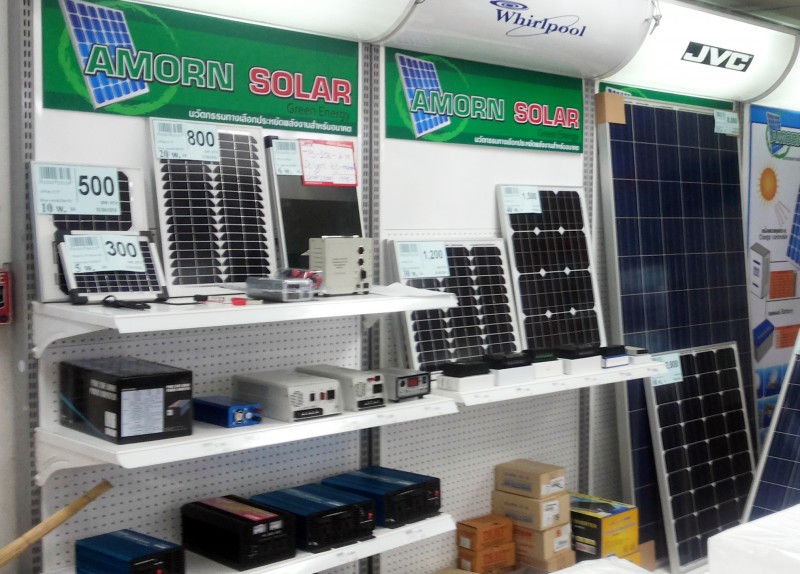
Dear conscious consumers, the fact is, you, and I, as electricity wasters in Phuket, are part of the problem. After all, guess where all of our power is coming from? Off-island fossil fuels! However, it is possible and ever-necessary for you to make a statement against the development of coal infrastructure, simply by reducing your own grid-power dependency today – now! One simple way you can do this is by installing a basic solar power (or wind) system at your home/villa at once. Tired of constant black-outs? With home renewable energy systems in Phuket already available between B30-70 per watt, this means for as little as B20,000 (about a 200-watt system with a battery and controller), you can have a basic “fossil fuel free” supplementary power system that will charge all your latest IT devices, lighting and even some fans or water pumps for the garden, for at least the next 20 years – that works out to less than B100 a month! Considering the dire situation in Krabi (which is happening because of 8 million plus consumers straining the grid for more power), it doesn’t make sense not to make the investment in renewable energy. So while Greenpeace does their part to campaign, don’t wait for the government to act/react, do something for yourself, for Southern Thailand, now and today. To consult about solar/wind home system installations, consider phoning up MonoSun Technology on 076 263 717. – Steven Layne, Life Editor Life