


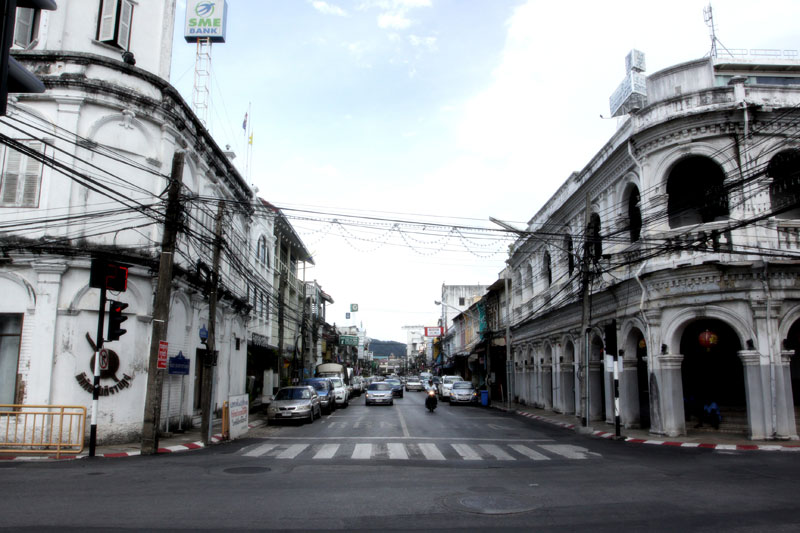
By talad, just one place was meant: Phuket Town’s central market place, the ‘old town’ as we might call it today.
The talad lay then, as it had for a hundred years, along Rassada, Ranong, Krabi, Yaowarat, Phang-nga, Dibuk and Thalang roads. On these roads were the island’s principal places of business – the banks, suppliers, grocers, dry goods vendors and fruit sellers.
The old Chartered Bank, at the corner of Phang-nga and Phuket roads, lay opposite a small police station, placed there, so it is said, because the city father of the time, Kaw Sim Bee, progenitor of the Na Ranong clan, feared bankers would not do business without the near presence of constabulary.
That was the first bank, and others sprang up nearby: it became the banking centre of the island. It still is. But the Chartered Bank is gone, its premises empty, as are those of the quaint, clock-tower-topped police station.
The clock stopped working a long time ago. So did many of the businesses.
Phuket’s imposing array of banks still subsist, but their neighbours are abandoned shops, antique stores and artists’ galleries. The area has a run-down look, as if turning into a ghost town.
“It’s dead wood,” says lawyer Siripong Luenchavee, who has an office on Satun Rd, a stone’s throw from the sprawling pile of Krabi Rd’s Prapitak mansion.
Mr Siripong, who specialises in tax and property cases, is not optimistic about the area’s future. “I opened another office on Kra Rd, in the Bang Niao area, because my clients have no place to park, and traffic is congested, particularly when school is in session.”
He thinks the city’s decline as a business centre is directly related to the lack of parking, a point on which there is general agreement.
Says Phuket Municipality deputy mayor Kawee Tansukatanon: “A seven-storey parking garage was proposed, and Jui Tui (the island’s largest Taoist shrine, on Ranong Rd) has the land. But no one was found willing to invest. They’re all afraid.”
Traffic congestion is an issue today in most of the island’s built-up areas. In Phuket town it’s especially trying.
“When the school term has begun, it takes an hour, sometimes longer, for me to get from work to home,” says Sumalee Titipuree, of Ruam Choke Karnka lumber yard on Surin Rd. She lives by Khao Rang Hill, perhaps a kilometre away.
Ruam Choke has been on the same site for over 35 years and supplies wood of all types to projects around the island. Mrs Sumalee says her records show construction is booming within Phuket Town’s municipal boundaries, but she admits it is “nearly all residential”.
For the flight of business from the town, she thinks modern technology and better distribution systems are partly to blame.
"I like convenience. The banks in Phuket’s old town are difficult to get to, and they take a long time time to answer the phone.
“So now I go to the branch near me, where the manager has time to be attentive; and I do the same things just as fast – I don’t need to go to the main offices.
“It’s the same with shopping: whereas before it was necessary to come into town to shop, now it isn’t. Everything is close to home. No one wants to come into the city anymore. They’re looking at their watches.”
Another reason for decline is cited by Chaowapong Mekarakkul, whose business interests include property, publishing, fish processing and entertainment, mostly in the the Phuket town area.
He explains, “When Poomperm Suwanakul built the Phuket Island Resort [now the Evason], it became plain that tourism was the future. All the old money clans poured investment into the beaches; and their children stayed there to look after the business. That’s where all the money’s gone.”
He thinks the future of the old town is tourism, as does nearly everyone. The problem is attracting tourists. “They should renovate the old buildings and make the new ones look old. Then tourists can admire the architecture, take pictures and enjoy themselves, like at Disneyland.”
Deputy mayor Kawee, keenly aware of the business district’s decline, is trying to attract tourists via conservation of Phuket’s unique culture.
“We contacted Unesco to submit our city for its Gastronomy Award. The Unesco Culture Unit chief for southeast Asia, Tim Curtis, came to see how we are training young people to make Phuket food – o-tao, mee hokkien and the like – so that it attains gastronomic status and hotels will be proud to serve it.”
He thinks that if Phuket is selected for the award, “It will put our city on the map as a place for gastronomes.”
He also sees value in the city’s klongs, which have occasionally been used for boat rides during the Old Phuket Festival at Chinese New Year. But the canals are often smelly, which rather ruins the romance.
“We pressure homeowners and businesses to refrain from pouring pollution into the klongs. The difficulty is that these waterways are some 20 kilometres long, originating in Kathu, where they have pig farms, and elephants and chickens, and the refuse all goes into the klong.
“If we could stop all pollution [in town], they’d still be polluted because of what happens upstream – we have no control over other tambons.”
He says some discussions about cleaning up the klongs took place a few years ago with the Provincial Administration Organisation. “But there’s been none recently and no budget was ever appropriated.”
Mr Kawee thinks that, to get the job done, “the central government must get involved”.
Mr Chaowapong says, “Twenty years ago I bought a quarter-rai shop on Phuket Road for B250,000. Today it’s worth about B2 million, an increase of about 10 times.
“But in some beach areas, land values have shot up 100-fold. “We need a way to pull tourists from Patong. A well-lit freeway and a tunnel would be useful, so they can get here.”
“Phuket should be a tax haven,” says Mr Siripong, the lawyer. “It’s the perfect place.”
A centre for gastronomes, a Disneyland, a tax haven – Phuket town could be any or all. But presently it’s none, and business is ebbing away.
In 10 years’ time will it really be what Mr Siripong calls it, “Dead wood”?