


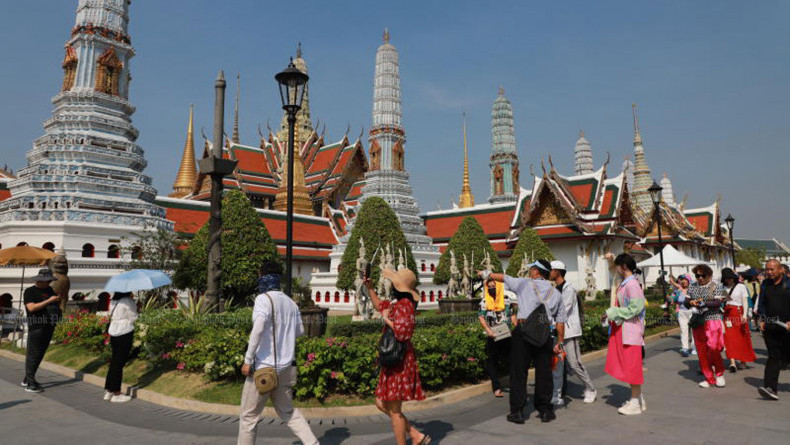
Tourism revenue from foreign markets tallied B1.2 trillion, recovering to only 60% of the B1.9trn posted in 2019, reports the Bangkok Post.
The rate is also below the Tourism Authority of Thailand’s goal of B1.6trn, while foreign arrivals totalled 28 million, or 70% of the 2019 level.
Japan, which reopened its borders months later than Thailand, recorded a new high in tourism revenue of US$35.8 billion, exceeding the pre-COVID level.
Sisdivachr Cheewarattanaporn, president of the Association of Thai Travel Agents, said Japan’s record revenue mainly derived from the weak yen, enticing foreign tourists to visit and spend on their products and services.
Mr Sisdivachr said expenditure in Japan was also driven by higher living costs, such as transport and accommodation.
Given its reputation for safety, unique culture and a service-minded attitude, Japan was able to lure an influx of tourists, he said.
Meanwhile, visitors to Thailand were mostly short-haul travellers, such as the Malaysian market, who were frequent visitors and unlikely to spend as much as long-haul tourists, said Mr Sisdivachr.
In addition, there were fewer Chinese visitors last year as Thai tourism was portrayed as unsafe on Chinese social media, he said.
Another roadblock for tourism is inefficient connectivity between large and second-tier tourism areas in Thailand, unlike in Japan or China where the mass transport network covers all regions, said Mr Sisdivachr.
“If Thailand wants to accommodate 70-80 million foreign tourists in the future, it’s essential to distribute them to second-tier provinces,” he said.
“The government must outline a plan, selecting new potential destinations to welcome tourists and build up necessary facilities to accommodate them, such as sufficient hotel rooms, attractions and connectivity.”
Marisa Sukosol Nunbhakdi, president of the Thai Hotels Association, said the revenue figures could be the result of an uneven recovery among hotels.
She said while many five-star hotels could raise their room rates above the 2019 level, the majority of hotels, mostly rated four stars and lower, were unable to charge a similar rate as prior to the pandemic.
Thailand has a glut of hotels, forcing many operators to reduce their prices, while Japan does not have this problem, said Mrs Marisa.
Tourism revenue can be maximised by increasing spending per trip and extending the length of stay, she said.
The government should entice niche markets that tend to stay longer in Thailand, such as the Mice (meetings, incentives, conventions and exhibitions) segment, digital nomads and medical and wellness tourists, said Mrs Marisa.
Promoting soft power, such as film locations and large festivals across all regions, will enable foreigners to travel year-round, she said. Mrs Marisa said Thailand’s arts and craft products are also popular with foreign tourists.
She said the special visa for foreign Muay Thai students is a good move, although it will have a minor impact because of its specific target.
China visa fears rebuffed
Meanwhile, the government has downplayed concern that its visa exemption policy for Chinese tourists may be exploited by some criminals to enter the country and operate illegal businesses here.
Kanchana Patarachok, spokeswoman of the Foreign Affairs Ministry, told a weekly media briefing yesterday (Jan 26) that Thailand and China have already worked closely together to combat transnational crime.
The visa-exemption policy must be separate from the enforcement of law, the Bangkok Post reports her as saying.
“The law must be strictly enforced to deal with transnational crime, while the visa-free policy is intended to make it easier for foreign travellers to enter the country,” Ms Kanchana said.
“When foreign visitors enter the country, they are still subject to immigration control anyway. [Criminal] records will be checked,” she said.
This comes as Chinese Foreign Minister Wang Yi is in Bangkok on a four-day official visit, where he will sign an agreement with Foreign Affairs Minister Parnpree Bahiddha-Nukara on a reciprocal visa-free scheme in which Thailand and China will permanently waive visa requirements for each other’s citizens from Mar 1.
Mr Wang will also sign an agreement to open Chinese consulates in Chiang Mai and Khon Kaen, Ms Kanchana said. Wang’s visit wraps up on Monday.
Prime Minister Srettha Thavisin, also the finance minister, revealed earlier that Thailand and China had agreed on the reciprocal visa-free scheme, describing it as upgrading Thailand’s previous visa-free programme for Chinese visitors, initially scheduled to last until Feb 29.
The mutual visa exemption, due to come into effect on Mar 1, will apply to holders of ordinary passports and public affairs passports between Thailand and China, according to the Foreign Affairs Ministry.
Regarding a two-day meeting which ends today between United States National Security Adviser Jake Sullivan and Mr Wang in Bangkok, Ms Kanchana said that Thailand had no role in arranging the meeting.
The meeting is the result of earlier talks between the US and China, she said, adding that Thailand hopes that the talks in Bangkok will lead to peace, stability, and prosperity in the region and across the world.
Thailand acknowledged the planned meeting between the US and China and was glad to be chosen as the venue for the talks, Ms Kanchana said.