


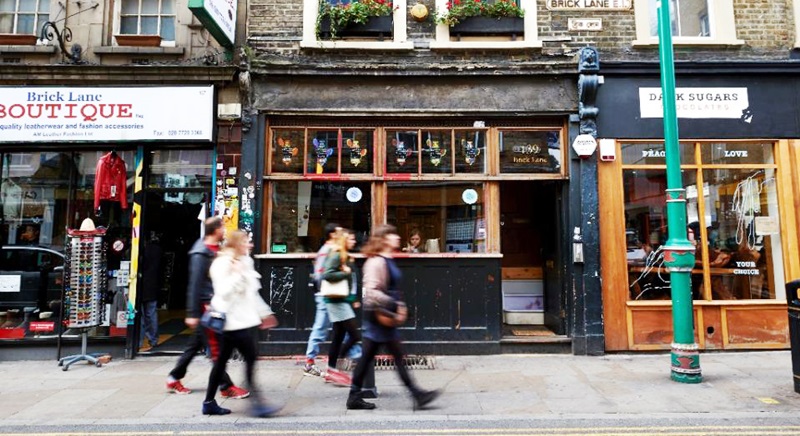
“Our communities are being ripped apart,” the “Class War” group said on its website ahead of violent protests which saw the “Cereal Killer Cafe” daubed in graffiti and bottles hurled in the street.
The activists blamed “oligarchs”, “sheikhs” and “scumbag property developers” for the proliferation of luxury flats unaffordable to most people.
Northern Irish entrepreneurs Gary and Alan Keery are of course none of the above.
But their cafe, bedecked in 1980s and 1990s memorabilia and selling over 120 brands of cereal at upwards of £3 (B163) a bowl, found itself at the sharp end of a growing anti-gentrification movement in a city where the cost of living is soaring.
Brick Lane, for decades the heart of London’s Bangladeshi community, is increasingly populated by the trendy hipsters now seen as synonymous with the once deprived local area, Shoreditch.
Paul Watt, reader in urban studies at Birkbeck University, London, believes last month’s protest was a reaction to a process of change whereby social housing has been replaced with luxury new developments, and small retailers supplanted by big business.
“It’s gentrification on steroids,” he said, describing the “growing corporatisation of retail space and housing”.
“Much of it is simply unaffordable for ordinary people. People are being pushed out of the city,” he said.
The average house price in the British capital stands at £430,000 (B23,490,025) and could rise to £1 million (B54,627,966) by 2020 if the rise continues at the current rate, according to property website Rightmove.
In the fight for affordable homes, dozens of campaign groups have sprung up across the capital, battling to save tower blocks and housing estates, as well as markets and local shops, from developers.
“Rents and house prices have rocketed,” said Eileen Conn, who runs the campaign group Peckham Vision in another rapidly changing part of London.
“It is a bit like being in a flood that we are caught up in... the global financial system pouring money into London property and pushing prices up everywhere, irrespective of local needs.”
Ms Conn, a retired civil servant, campaigns tirelessly on behalf of local traders in Peckham, now emerging as a desirable, fashionable area.
One man who feels unjustly affected by the changes is Peckham market trader Yassine Melki who has sold home textiles there for almost 25 years.
Plans for a new gym near his stall now means he is being forced to move from a busy thoroughfare to a quieter spot where he fears custom will be harder to come by.
“I feel really let down. It is these big companies - we are too small for them, they do not care how we are going to look after our families,” said the Algerian-born father-of-three.
Southwark Council, which ordered Mr Melki to move his stall, argues that it is part of a bigger plan to redevelop the area that will ultimately attract more business.
But Ms Conn, who is supporting the market trader’s case, sees it as a “recurring theme” of established businesses being “brushed aside”.
“Self regeneration is being pushed aside for big faceless corporations,” she said.
In April hundreds of anti-gentrification protesters in Brixton, southeast London, took to the streets, angry that local residents and businesses were being driven out of the area by rising rents. Rioters smashed the window of an upmarket estate agents.
While the owners of the Cereal Killer Cafe can hardly be seen as representing big corporates, the area in which they operate is experiencing the same tensions.
Kristian Niemietz, head of health and welfare for the Institute of Economic Affairs, believes anti-gentrification protesters are as irked by the erosion of “coolness” as they are by rocketing house prices.
“The reason why people get attracted to these areas is they acquired a reputation as being trendy or cool... it becomes a status symbol to live there,” he said.
“The thing with status symbols is that they lose their value when more people acquire them.”