



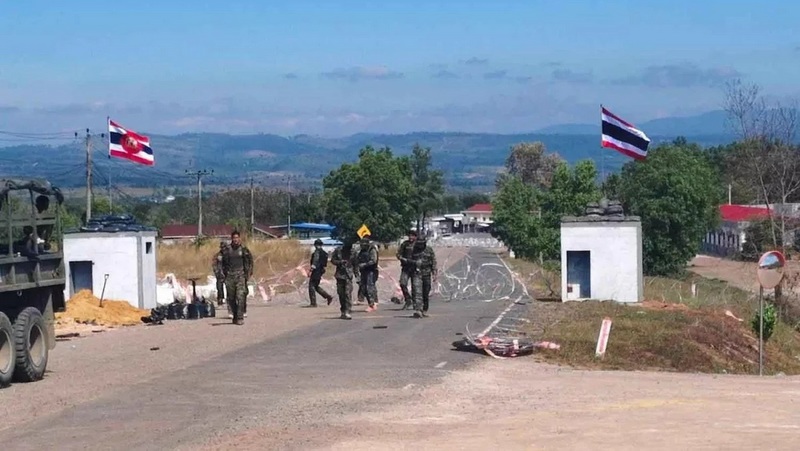
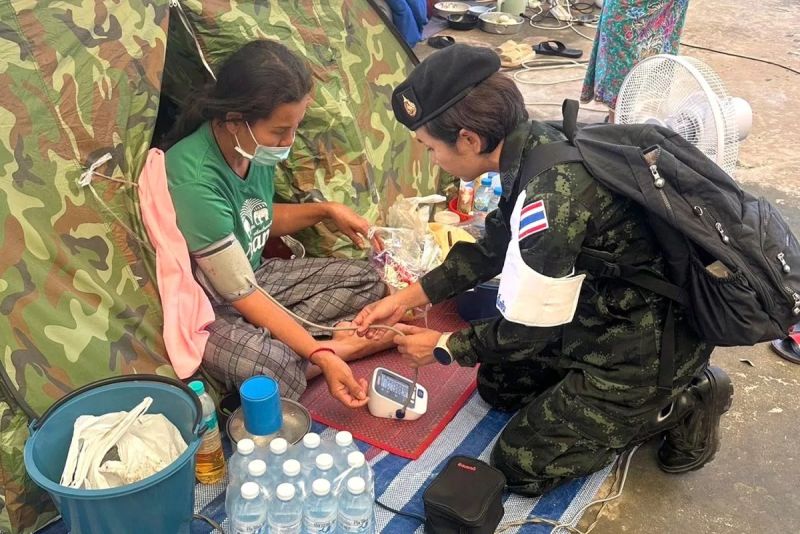
Provincial authorities organised convoys to take evacuees from shelters back to their communities, while security forces rushed to clear unexploded ordnance and assess damage caused by recent clashes, reports the Bangkok Post.
Prime Minister and Interior Minister Anutin Charnvirakul said yesterday (Dec 29) the government is only allowing people to return to areas deemed safe, emphasising that public safety remains the top priority.
Speaking before departing to inspect border areas in Buriram, Surin and Amnat Charoen, he noted the number of evacuees has already dropped sharply since the ceasefire agreement.
In Buriram, for example, only about 2,000 of the 20,000 evacuees remained in shelters as of yesterday.
In Buriram’s Ban Kruat and Lahan Sai districts, villagers expressed relief and joy as they boarded buses and songthaews home after more than 20 days away.
While praising the care provided in shelters, many said nothing compared to returning home. However, concerns remain that future clashes could erupt.
Residents called on the government to build a clear border fence or wall and tighten checkpoint controls to prevent renewed conflict, while also expressing condolences for soldiers who lost their lives.
In Surin, residents began inspecting homes and farmland after authorities allowed their return on Sunday.
Although fighting has ceased, Explosive Ordnance Disposal (EOD) teams remain active.
Checks identified 483 unexploded artillery shells and BM-21 rocket remnants across several districts, prompting intensive clearance operations.
Sa Kaeo officials reported damage to 116 homes, including eight completely destroyed by BM-21 rockets, and confirmed compensation of up to 230,000 baht for repairs per property, along with assistance for rent and essential household items.
High-risk areas, such as Ban Khlong Phaeng and Ban Nong Samet in Ta Phraya district and Ban Nong Chan and Ban Nong Ya Kaeo in Khok Sung district, remain off-limits until cleared by EOD teams, the army said in an update.
Meanwhile in Trat, where no fighting occurred, villagers showed solidarity by cooking hundreds of meals for soldiers stationed along the border.
Border hospitals slowly reopening
Meanwhile, with the truce with Cambodia in its second day, hospitals near the contested border were beginning to reopen yesterday.
Kantharalak Hospital in Si Sa Ket had fully reopened, and Kap Choeng and Phanomdongrak hospitals in Surin were partly operational yesterday reports the Bangkok Post.
The hospital in Kanthararak district of Si Sa Ket resumed all normal services, Kap Choeng Hospital was open for out-patients and emergency cases, and Phanomdongrak Hospital for emergency cases, Eakachai Prompetchara, spokesman for the Ministry of Public Health, said.
The ministry had ordered continuous monitoring of the situation, Dr Ekkachai said.
Six other border hospitals remained closed - Phusing Hospital in Si Sa Ket, Ban Kruat Hospital in Buri Ram and Ta Phraya, Khok Sung, Khlong Hat and Aranyapreathet hospitals in Sa Kaeo.
The fighting between Thai and Cambodian forces along the border had forced many hospitals and health facilities to close since early December. The ceasefire agreement was signed by both countries and took effect at noon on Saturday.
In Sa Kaeo, evacuees were expected to begin returning to homes tomorrow, after the anticipated end of the crucial first 72 hours of the ceasefire today, the spokesman said.
Sa Kaeo public health office will provide ambulances for bed-ridden patients. The intention was to resume health services in the eastern province as soon as possible.
Medical staff were monitoring mental health and providing support to those affected by the border conflict, along with disease surveillance in their communities for 14 days, Dr Ekkachai said.
Currently, there are 660 temporary shelters with 80,981 occupants, according to the ministry.