


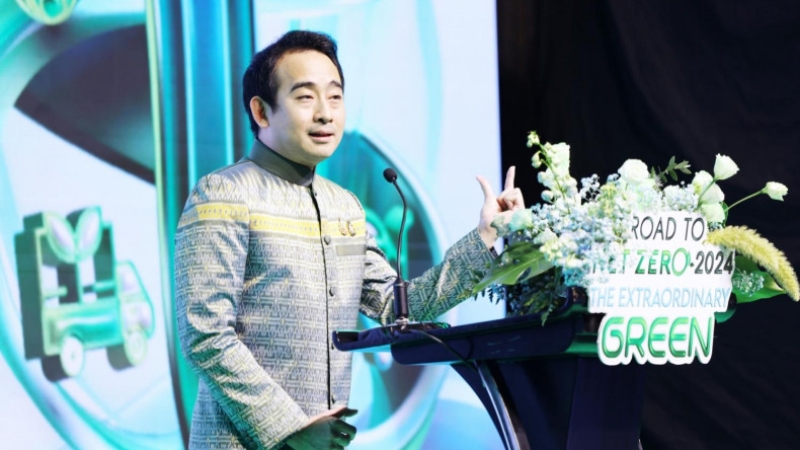
In his speech at the ‘Road to Net Zero 2024: The Extraordinary Green’ event, Mr Paopoom said the Finance Ministry will soon propose the carbon tax measure to the Cabinet for approval, aiming for implementation within months, reports the Bangkok Post.
He said the measure would incentivise businesses to reduce carbon emissions and would not burden the public.
As an example, the combustion of all types of fuel oil contributes to carbon emissions in the atmosphere. Mr Paopoom said that if the carbon tax is implemented, the current excise tax rate will remain at B6 per litre, but the Excise Department will split the tax burden into two parts: B5 as the excise tax and B1 as the carbon tax.
Under this tax structure, fuel users will not face an additional tax burden, while the tax burden for oil companies may increase, decrease or be maintained, depending on how well they manage their carbon emissions. The greater the reduction, the lower the tax burden, he said.
Thus, every tonne of carbon emissions from businesses will carry a cost, as each unit of carbon released will be multiplied by the carbon tax rate, which will be borne by the businesses.
He emphasised that the carbon tax will persuade businesses to reduce carbon emissions.
In addition, he said that in the future the Excise Department will change the excise tax structure for batteries to a tiered system, moving away from the current flat rate of 8%. The new tax structure for batteries will have a higher tax rate for batteries with higher carbon emissions and a lower tax rate for batteries with lower carbon emissions.
Moreover, businesses that significantly reduce their carbon emissions could potentially receive a tax refund through a reverse tax system.
According to Mr Paopoom, Thailand has international commitments to meet so that by 2030 the country must have reduced carbon emissions by 30-40% from current levels. By 2050, Thailand should achieve carbon neutrality, and by 2065 the country should reach net zero emissions.
“If we continue as we are, we will not meet the 2030 goal,” he said, adding that the world is increasingly moving towards “green” standards, where products must be certified as environmentally friendly.
Global trade barriers have been increasing by 16% annually over the past 10 years, resulting in as many as 18,000 trade barriers currently in place.
However, only 7% of Thailand’s exports are environmentally friendly, while the country’s use of clean energy accounts for just 13-14% of total energy consumption. This is still very low compared to neighbouring countries like Vietnam, where the share of clean energy is 19%.