


But the latest draft approved by the Cabinet will significantly limit how many Thai punters can go to casinos, with an entry fee of B5,000 and proof of at least B50 million in bank deposits, effectively blocking large swathes of the population, reports the Bangkok Post.
Deputy Finance Minister Julapun Amornvivat said earlier this month that the assets requirement for Thai nationals would probably be scrapped because it would exclude too many people. He said officials had decided to submit the draft in its current form and deal with possible amendments later.
Prime Minister Paetongtarn Shinawatra told reporters yesterday that the details of the law were not final as parliament would have the final say.
The bill will be sent to the House of Representatives, and if passed, will also need approval from the Senate and His Majesty the King.
Another restriction in the draft is that the casino area may only occupy up to 10% of the entire space of an entertainment complex, according to a government statement.
Gambling is mostly banned in Thailand apart from state-controlled horse racing, the lottery and on some sports, but successive governments have pressed the case for allowing casinos to draw in more foreign visitors and create more jobs and state revenue.
Government spokesman Jirayu Houngsub said the bill would require public hearings to be held in locations proposed for entertainment complexes, and compensation to be paid for any negative impacts.
Operators of the complexes would be prohibited from linking gambling at casinos to any computer system, broadcasting gambling at casinos or trying to increase the number of players and bets. Casino operations would also be subject to the anti-money laundering law, he said.
“The government supports entertainment complexes mainly to stimulate the economy, investment and tourism,” said Mr Jirayu.
A Citi report late last year estimated that about half of people aged 20 and more in Thailand could be casino players, providing a base for the country to potentially become the world’s third-largest gambling destination.
B100 billion in investment targeted
The government hopes to attract at least B100 billion in new investment in casinos and entertainment complexes and see an annual boost to foreign arrivals of 5% to 10%, while generating revenue of more than B12bn a year.
Several countries in Southeast Asia have legalised casinos, but only a few like wealthy Singapore have been successful in drawing global giants such as Las Vegas Sands, thanks to robust regulations.
Mr Jirayu said that 80% of the 71,300 respondents to an online public hearing conducted from Feb 28 to Mar 14 expressed support for the bill.
However, a recent public opinion poll showed that a majority of people are worried about the negative effects of legalised gambling.
The opposition People’s Party also pointed out that legalising gambling could backfire on tourism if China discourages its citizens from visiting Thailand as a result.
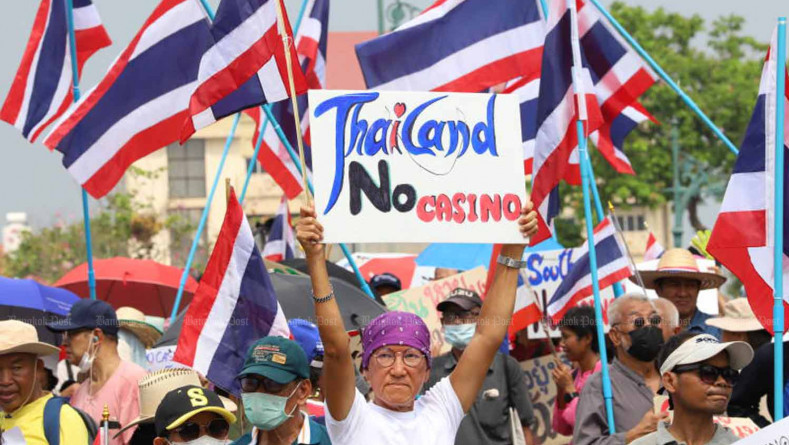
The presence of the entertainment complex bill on the Cabinet’s agenda drew about 80 protesters to Government House yesterday.
Pichit Chaimongkol, a leader of the rally, said entertainment complexes and casinos were not in the policy statement Prime Minister Paetongtarn Shinawatra made to parliament but were being pushed by Thaksin Shinawatra, the prime minister’s father.
“The promotion of vices is tantamount to tempting people to take the wrong direction and opposite to developing the quality of life to improve people’s well-being,” he said.