


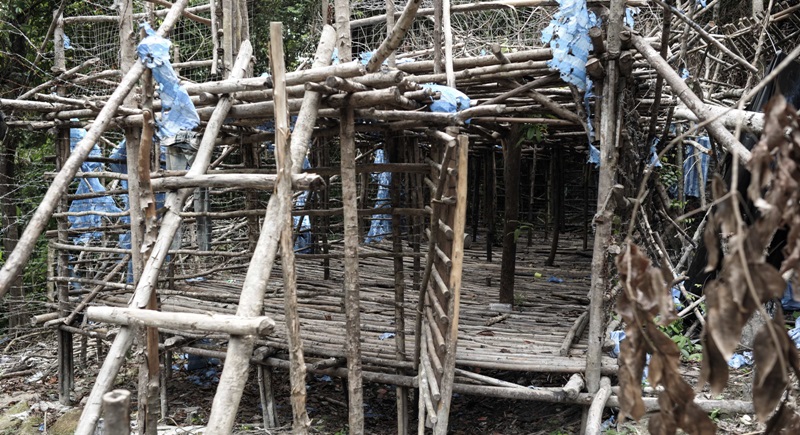
Police escorted journalists on a gruelling hike into a thickly jungled state park in northern Malaysia where authorities have found 28 such camps in the latest grim turn in Southeast Asia's migrant crisis.
Fearing possible attack from armed traffickers lurking in the woods, police advised reporters to hit the ground if they heard any gunshots during the four-hour round-trip slog up a remote mountain.
Via a jungle path that was clearly well-trodden, reporters were led to a single small camp in a forest clearing, where barbed wire surrounded two rickety structures made of jungle saplings and bamboo, with tarpaulins lying on the ground.
Nearby, police carrying shovels and white body bags dug up a grave, pulling out a corpse apparently wrapped in a Muslim shroud.
"We have found 37 graves (at the camp) but we have only recovered one body so far," said local police official Muhammad Bahar Alias.
Malaysian police have said a total of 139 gravesites had been found near abandoned camps spread out along the border and capable of housing hundreds of people.
Malaysian police said it remained unclear how many bodies were buried in the inaccessible corner of mountainous jungle just a few hundred metres from Thailand.
But the Malaysian findings appeared to indicate a system of camps and graves larger than those over the border.
The camp visited yesterday seemed largely to have been picked clean of most evidence indicating what went on there.
But on the ground lay a human lower jaw with several teeth still in it.
A low cage-like pen also could be seen, but it was unknown whether it was used for livestock or people.
- Sandals and a teddy bear -
Photos from some of the other camps, provided by police, indicated the presence of small children, including a pair of sandals fit for a toddler, and a pink teddy bear.
Several Malaysian villagers had told AFP on Monday (May 25) that bedraggled Bangladeshi and Rohingya migrants had become a common sight in the area weeks before the current crisis erupted.
Some bore ugly scars or had bloodied feet from trekking across the frontier, and would beg locals for food and water.
Many were later picked up in private cars and driven away by unknown people, residents said.
Along with Thailand, Malaysia's government has long been accused of not doing enough to stop illegal migration and human-trafficking that puts poor and vulnerable migrants at risk of exploitation, extortion and death.
The US State Department's annual human-trafficking report lists both countries on the lowest-possible tier, for nations that are failing to stop the trade.
Activists say the trade thrives likely with the help of corrupt Malaysian and Thai officials.
Before the discovery of the graves, government officials had dismissed the suggestion that such sites existed on Malaysian soil.
But Home Minister Zahid Hamidi said yesterday the government now suspects human-traffickers and enforcement officers could be in cahoots.
"Our investigations showed that they are collaborating with each other, not only (locally) but they have international links including Thai, Bangladesh and Myanmar," the Malaysian Insider news portal quoted him saying.