


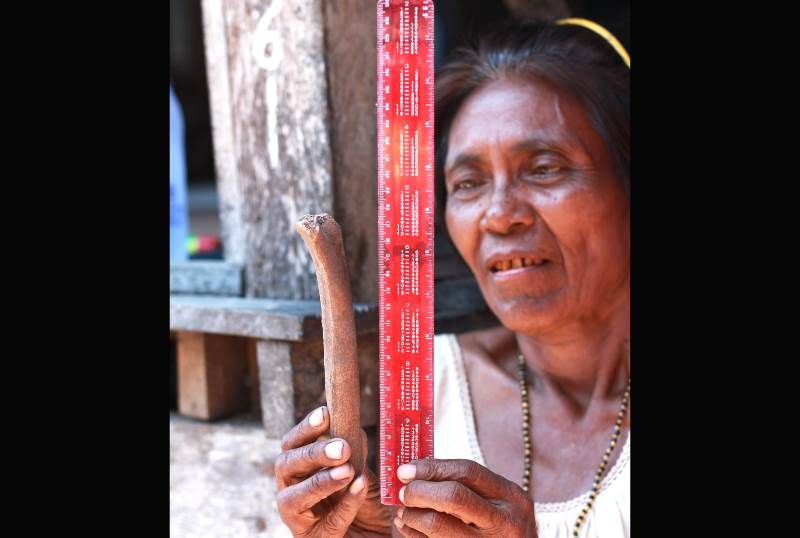
Villagers believe it is proof that they and their ancestors lived there long before local businesspeople claimed the land under the village for themselves and obtained land ownership papers.
The Rawai Sea Gypsy community recently lost an initial round in what promises to be a long-drawn-out court fight over ownership of the land. The community have so far been unable to find evidence of their claim compelling enough to have the land papers rescinded.
The bone was found yesterday evening by Wak Lakkoh, 62. She and neighbours were digging a hole to replace one of the wooden uprights supporting her house when she found the 17-cm-long bone, believed to be a part of a human arm. Full scientific tests will be need to be carried out to confirm if it is a human bone, and how old it is.
Nirun Yangpan, Rawai Sea Gypsy representative said that, 30 years ago, Mrs Wak found an almost complete human skeleton underground near her house, along with some antique pottery, but threw them into the sea because she believed that having a skeleton under her house would bring bad fortune.
“It was unfortunate; at that time she didn’t realise that the bones might be important evidence,” Mr Nirun said.
“However, after we had been fighting [the legal battle] for the land for a while, we started thinking about finding some proof of our long-term occupation of the land.
“An elder told me there might be as many as 10 skeletons here so we have kept on digging the whole day.”
He added that, in centuries gone by, when someone died, family members would always bury the body in the area around the house, along with some of the dead person’s belongings.