


I feel like reminding everyone that schools also have to prepare students for the many jobs that will continue to exist as long as the human species survives. Technology is a game changer, but it is still a tool. As a tool it enhances a great many traditional professions and in a great many places it alters the workplace itself. It will even spawn new jobs, but the vast number of our students will still pursue careers and professions that have been around for quite some time.
Of course, the purpose of the cliché is to prepare us for the real message concerning the vital importance of ‘creativity’. It is no good preparing students to rote learn and to pass the traditional examinations; we must produce a breed of student that is able ‘to think outside the box’ (sorry, the clichés just seem to be tripping off the tongue).
This is true. The world needs independent thinkers and problem solvers. The real problem, however, is that schools also have to get students into jobs and universities, and the qualifications required to open doors are most often still based upon grades, and test scores and examinations. Government assessments of educational systems and social capital are, again all too often, based upon grades, and test scores and examinations; many parents are also, understandably, pre-occupied with grades and test scores and… you get the picture.
It seems that schools, and educational systems, have done quite a good job of actually stifling the natural creativity that human beings possess. Despite this, and with little sense of irony, the focus now seems to be upon schools developing creativity in their students.
Of course, there is an underlying assumption that ‘creativity’ can be taught; and that certain creative activities will somehow transform our curricula; but can a state of mind be taught at all?
A creative mind really needs to be an enriched mind, and that has little to do with knowing where to access information when it is required. I really like the expression ‘a cultured mind’, rarely used these days. It implies much more than just utilitarianism.
The emphasis on preparing our children for the world of work or for citizenship, supported by the technological skills to access information, has slewed the curriculum away from subjects such as literature, history and classics because they are perceived to have little practical application in the hi-tech workplace (and could even be quite dangerous for our embryonic citizens).
Despite the emphasis on carefully choreographed – I naturally hesitate to the use the word ‘rigid’ – curricula, there seems to be little overt concern with the ‘enrichment’ of minds. And, as we all know, the one thing we are stuck with, and cannot trade-in, is our mind. Basically, it is all we have and all we are; enriching it, therefore, seems like a good idea, especially if we are in it for the long haul.
Much recent research in education is now focused upon ‘resilience’ – the ability to bounce back; to learn from error; to fail well. I might just as well add, to overcome the stranglehold of the curriculum.
So how does bottom-up brain friendly, enriched and creative education mesh with a top-down, narrow, prescriptive, grade obsessed examination curriculum?
Schools must ‘not throw the baby out with the bath water’ (I just love those clichés). While it is important to provide an education that a young brain needs for growth and to make all those synaptic connections, it remains just as important to ensure that students, as they grow older, are resilient enough to achieve success within the narrow confines of imposed examination curricula.
The world will change, but schools are by their very nature conservative institutions. The change in schools will be slow.
To get the best out of each child is not easy; we can coerce children and reward them, of course, but if the motivation is always applied externally, we are ultimately setting them up for long term failure.
If the work is not challenging enough, the overall grades might improve, but the learning will not.
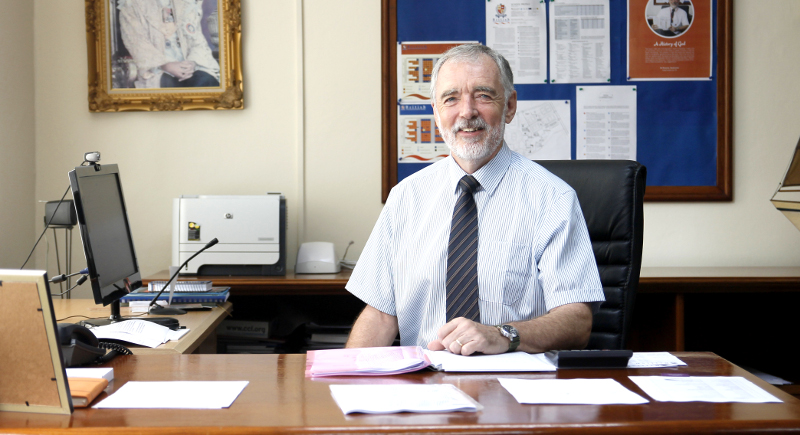
Neil Richards MBE is the Headmaster of British International School, Phuket (BISP) and can be contacted at headmaster@bisphuket.ac.th. The views expressed here are his own. To learn more about the school, visit www.bisphuket.ac.th