


At the same time, the government has defended the use of the Sinovac vaccine and its plan to purchase 12mn more doses to combat the Delta variant of COVID-19 after the most recent study of those who received two doses of Sinovac showed satisfying results.
These procurement projects are part of the Disease Control Department’s plan to procure all 100mn doses of various types of COVID-19 vaccines by the end of the year, said government spokesman Anucha Burapachaisri after the cabinet meeting yesterday (Aug 17).
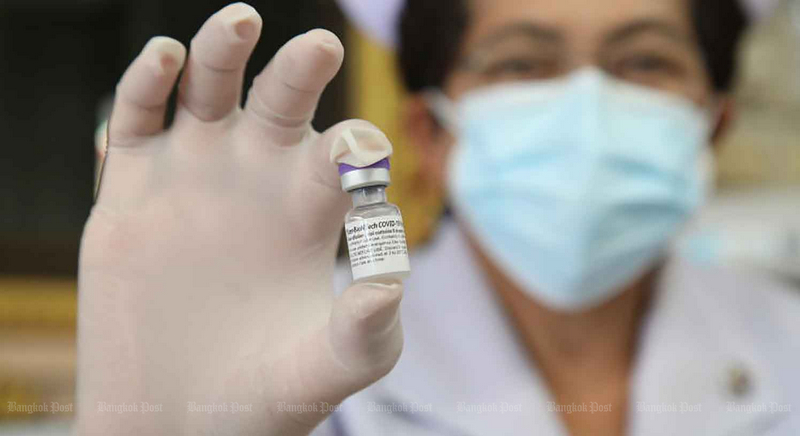
“Altogether, Thailand now expects to have about 30mn doses of the Pfizer mRNA vaccine by the fourth quarter of this year,” he said.
Mr Anucha said Prime Minister Prayut Chan-o-cha expressed his thanks to all agencies having a part in bringing the 30mn doses of the Pfizer mRNA vaccine to the country as well as those responsible for its nationwide distribution.
He said the cabinet also decided to sign an agreement with Bhutan which will donate around 130,000-150,000 AstraZeneca doses to Thailand and it acknowledged that Germany wanted to donate between 1,000-2,000 monoclonal antibody sets to Thailand.
The government’s committee on COVID-19 vaccine procurement reported to a recent meeting of the Centre for COVID-19 Situation Administration (CCSA) about all existing vaccine procurement plans and updates on vaccine imports, details of which were released to the cabinet meeting.
The plan to purchase another 10mn doses of the Pfizer vaccine was also approved by the CCSA meeting, said a source.
According to the reported plans, since February a total of 84.22mn doses of Sinovac, AstraZeneca and Pfizer COVID-19 vaccines have been ordered.
Of this number, 24.92mn doses were delivered as of July, while the rest will arrive by December.
Of the 84.22mn vaccine doses, about 13mn doses of the Sinovac vaccine were delivered between February and July. A further 8mn Sinovac doses will arrive by December. There was no mention of the additional 12mn Sinovac vaccine that the government confirmed they had purchsed yesterday (see below).
A total of 11.92mn AstraZeneca doses arrived in February, while the other 29.8mn doses are being delivered by December.
The 21.5mn doses of the Pfizer vaccine will be delivered by December.
A proposal to negotiate for a contract to procure about 26mn doses of the COVID-19 vaccine for next year via the COVAX Facility, was also discussed and approved at Monday’s meeting, said the same source.
COVAX is a worldwide initiative aimed at equitable access to COVID-19 vaccines directed by Gavi, the Vaccine Alliance, the Coalition for Epidemic Preparedness Innovations (CEPI), and the World Health Organization (WHO).
In principle, a total of 120mn doses of various types of COVID-19 vaccine will be procured next year, including the mRNA vaccine, the viral vector vaccine, the inactivated vaccine, the protein subunit vaccine and the DNA vaccine, said the same source.
As for the management of the 1.5mn doses of the Pfizer vaccine donated to Thailand by the US, it was agreed at the same meeting that some adjustments should be adopted to make it more flexible to administer the 150,000 doses set aside for expatriates, said the source.
It was also agreed that diplomats aged under 60 and other groups of foreigners living in Thailand should also be included in this specific COVID-19 inoculation programme, said the source.
Government defends its purchase, use of Sinovac to fight Delta strain
Meanwhile, the Public Health Ministry yesterday held a press briefing to provide an update on the continued use of Sinovac and its efficacy after the public questioned why an additional 12mn doses of the vaccine were included in its August-September COVID-19 vaccine procurement plan. The public called for the government to instead procure mRNA vaccines which many believe are better than Sinovac.
Chawetsan Namwat, the Department of Disease Control’s director for emergency health hazards and diseases, said that all vaccines approved by the WHO, including Sinovac, are good enough to reduce critical symptoms and death, which is the prime focus of vaccines and should not be devalued. The key point right now is how to provide the vaccines to people en masse as fast as possible to control the disease and reduce loss of life.
“We need to provide vaccines to as many people as possible. The combination vaccine is the answer to administering the vaccines en masse and enhancing people’s immunity faster than a single vaccine with two doses. We are going to order 12mn more doses of Sinovac to combine with the limited amount of AstraZeneca,” he told the press conference.
Taweesap Siraprapasiri, the ministry’s expert, said that the ministry has just finished its study of COVID-19 vaccines’ efficacy on 3,901 medical staff countrywide. The test was done for both Sinovac and AstraZeneca.
Dr Taweesap said regarding the Sinovac vaccine, the results showed that its efficacy in preventing critical illness and death is 98% and its efficacy in stopping COVID-19 infections is 72% on average.
The results of AstraZeneca were even better, with 96% efficiency in preventing infection after two doses with an interval of over 14 days among vaccine recipients, falling to 88% after only one dose.
Thailand logged a record 239 new COVID-19 fatalities and 20,128 new cases over the previous 24 hours, the Public Health Ministry reported yesterday.
The previous high of daily COVID-19 fatalities was 235 on Aug 10, when there were 19,843 new cases. The all-time high of daily COVID-19 cases in Thailand was the 23,418 reported on Friday.