


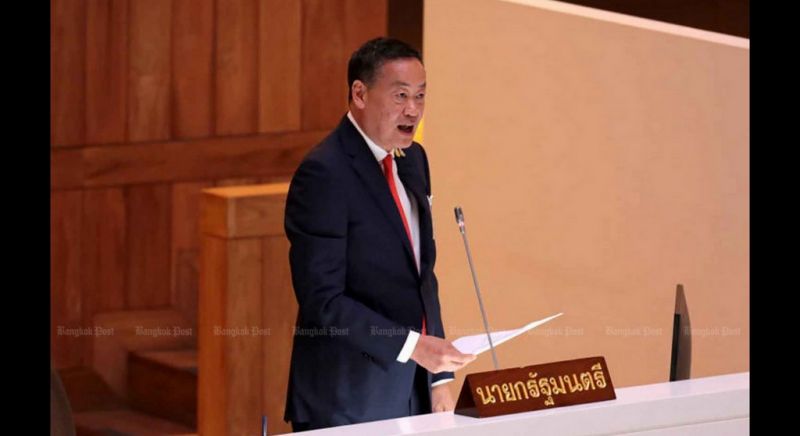
“For the wage rise, there will be negotiations between three parties - workers, employers and the government - for a reasonable level of the minimum wage. The goal of B400 will be achieved as soon as possible,” the prime minister said yesterday (Sept 12) during the second and last day of a debate on the government’s policy statement in parliament.
A wage increase to meet workers’ needs is one of the government’s economic stimulus measures, he said.
During the election campaign, the ruling Pheu Thai Party pledged policies that included raising the minimum daily wage to B600 by 2027, reports the Bangkok Post.
“Our country is fortunate, with the unemployment rate only at 1%,” said Mr Srettha, who concurrently serves as finance minister.
“While many people have work to do, demand for labour is still high. Therefore, it is still necessary to depend on migrant workers.
“We also have to protect migrant workers’ rights and people’s dignity as well as provide them with welfare and safety,” he said, adding the new government plans to set up a one-stop service centre to improve efficiency in handling their documentation.
Other measures to stimulate the economy included new tourism drives and reduced energy prices for households and logistics operators, Mr Srettha said, adding he would instruct the Energy Ministry to take urgent action to lower utility bills.
“The government is not ignoring the people’s plight. I thank [the opposition] for their warnings,” he said.
“Some MPs have also talked about issues related to motorcycle taxi drivers. Actually, the government’s relief measures cover motorcycle taxi drivers, taxi drivers, delivery riders and transport operators.
“We have heard their concerns before and since the election. Some [taxi drivers] complained their current fares, which start at B35, have not been changed for a long time.
“They are not protected by labour laws. Several laws are still outdated. I have instructed the labour minister to look into the matter,” Mr Srettha said.
The government will try to ensure taxi drivers who use both motorcycles and cars receive fair rates, he said.
“The Transport Ministry will study the possibility of developing a government-owned ride-hailing application to support these drivers,” he added.
Mr Srettha was responding to criticism from Sia Jampathong, a Move Forward Party MP, who debated the government’s labour policy in parliament.
Mr Sia said he was disappointed Mr Srettha had failed to come up with a detailed labour policy despite promising to do so during election campaigning.
“I want the prime minister to be informed that current wage rates are not enough for workers to make ends meet. They don’t receive enough protection,” Mr Sia said.
He pressed the prime minister to push for a daily minimum wage of B600 and a B25,000 salary for graduates with bachelor’s degrees.
“You must keep your promises. Otherwise, you will be in trouble. You said the minimum daily wage would be raised as quickly as possible. But you must specify when,” Mr Sia said.
Suchart Chantaranakaracha, the vice-chairman overseeing labour affairs at the Federation of Thai Industries, said any wage increase must be considered by the tripartite national wage committee first, comprising representatives of employers, employees and various state agencies.
He said inflation, labour productivity, employers’ ability to pay wages, and economic growth must all be considered.
The daily minimum wage currently varies from one province to another, ranging from B328 to B354. The latest wage rise was in October last year. The highest daily rate of B354 has been approved for Chon Buri, Rayong and Phuket.