


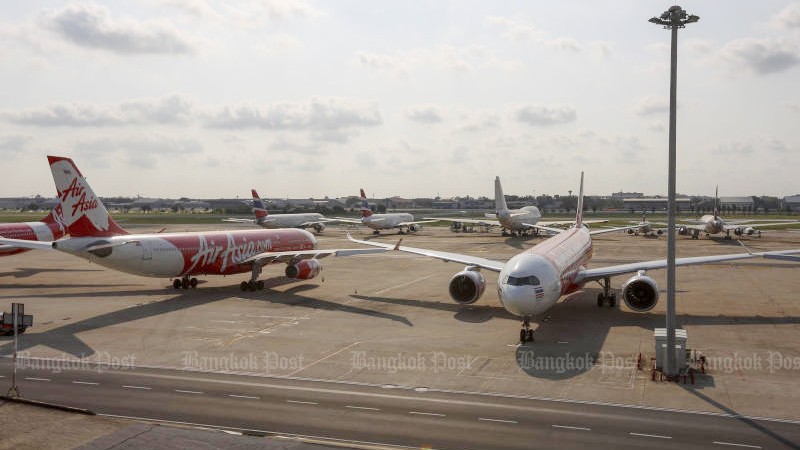
Fiscal Policy Office director-general Lavaron Sangsnit said after a meeting with eight airline operators that the ministry had agreed in principle with the lifeline measures but needs additional details from the carriers, reports the Bangkok Post.
The eight carriers are Bangkok Airways, Thai AirAsia, Thai AirAsia X, Thai Lion Air, Thai Vietjet Air, Thai Smile, NokScoot and Nok Airlines.
A separate negotiation for the government to provide liquidity to support the deeply distressed national carrier, Thai Airways International, is also ongoing.
The ministry will use the outcome of Friday’s talks with the eight airlines in policymaking discussions later, Mr Lavaron said.
The meeting of the two sides, the first since the pandemic began hammering the aviation industry almost three months ago, is sparking hope that the eight airlines wll be able to survive the crisis, said Nuntaporn Komonsittivate, head of commercial services at Thai Lion Air.
Although the ministry didn’t nail down the amount of soft lending or the interest rate, all airlines intend to provide more details as requested by authorities, Ms Nuntaporn said.
“We still have to work on a more elaborate financial plan after this meeting, but in principle all airlines are giving priority to airline staff,” she said.
Of the B25 billion proposed, Thai Lion Air has requested B3.75bn for manpower and preparations to restart domestic flights on May 1.
Thai Lion Air will resume daily flights on routes that connect Don Mueang airport to Chiang Mai, Ubon Ratchathani, Khon Kaen, Surat Thani, Hat Yai and Nakhon Sri Thammarat.
Ms Nuntaporn said TLA would operate the flights under stringent health and safety measures, particularly with regard to seat allocation.
Passengers must wear face masks and keep their distance from other passengers. The airline will also refrain from selling food and drink on flights.
Santisuk Klongchaiya, chief executive of Thai AirAsia, said TAA would resume domestic operations from May 1, providing services for guests who need to travel for either personal or business reasons.
The routes to resume service include Don Mueang to Chiang Mai, Chiang Rai, Khon Kaen, Udon Thani, Ubon Ratchathani, Nakhon Panom, Roi Et, Nakhon Si Thammarat, Trang, Hat Yai and Surat Thani, as well as Chiang Mai-Hat Yai.
Prayut to chair meeting on THAI’s fate
The government will decide the fate of ailing Thai Airways International Plc (THAI) in a meeting of the State Enterprise Policy Commission next Wednesday (Apr 29), with the possibility of a shareholder restructuring to help the national carrier stay afloat.
The meeting will determine the condition and scope of rehabilitation for the national carrier, and will be chaired by Prime Minister Prayut Chan-o-cha.
To prepare for the final draft of the rehabilitation plan, Deputy Prime Minister Somkid Jatusripitak on Friday called urgent talks with Transport Minister Saksayam Chidchob and Finance Minister Uttama Savanayana to discuss the hotly contested issue – whether the national flagship carrier should maintain its status as a state enterprise under the Transport Ministry, reported the Bangkok Post.
Mr Saksayam told media that the future share structure was not discussed at that meeting. He hinted that THAI executives had been tasked with drawing up plans on how they would resurrect the company from years of financial woes before the Wednesday meeting.
“Some issues are too sensitive to talk about now,” Mr Saksayam said.
“I believe Mr Somkid and the finance minister have today seen the best way to keep the national aviation business healthy,” said Mr Saksayam.
Faith in THAI has increasingly captured headlines, with COVID-19 battering the financially beleaguered airline.
After the outbreak, the national carrier was forced to implement furloughs and slash salaries. There have been unsubstantiated reports that businesses with deep pockets could become substantial new shareholders.
To put those rumours to bed, Mr Somkid reportedly stepped in last Thursday by establishing an ad-hoc panel to find ways to rehabilitate the 60-year-old carrier amid a report that the Finance Ministry will have the Government Savings Bank and the Vayupak fund, with state-owned Krung Thai Bank as its major shareholder, acquire more shares in THAI.
As of now, the Ministry of Finance owns 51.03% of the shares, leaving 15.12% with the Vayupak 1 fund and 2.13% with the Government Savings Bank.
Deputy Transport Minister Thavorn Senniam said that one potential plan is to have the Finance Ministry reduce its share, allowing the Vayupak fund to increase its stake, said Mr Thavorn.
He said with Vayupak fund as a major shareholder, THAI would be forced to operate more efficiently like other SET-listed companies.
Mr Thavorn ruled out rumours that private investors will become major shareholders.
“This direction is impossible as it is tantamount to privatising the national carrier,” he said.
Other options are requests for more funding, the issuance of corporate bonds or a capital increase, he said. Financial experts will know which path is best for THAI to prevent it from further losses, said Mr Thavorn.
He said only Gen Prayut’s commission and the cabinet can decide on the shareholder issue, and regardless of the restructuring, THAI will survive.
“THAI will not collapse. The fact that Deputy Prime Minister Somkid stepped in to handle this issue means the government will rescue it,” said Mr Thavorn.