


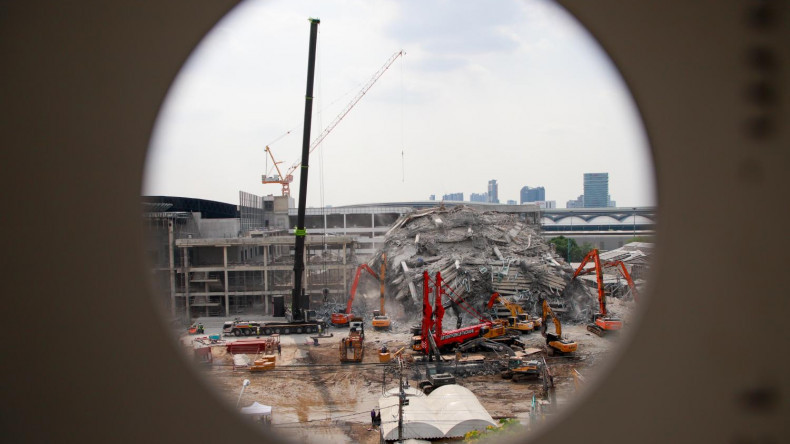
She said the 30-storey State Audit Office (SAO) building that collapsed during construction last Friday was included in the IP scheme after bidding had taken place, reports the Bangkok Post.
Ms Patricia said in fiscal 2020, the SAO submitted information about the project to the Anti-Corruption Cooperation Committee (CPT Committee) for consideration to join the IP programme.
The project was still in the process of determining a median price, and a CPT subcommittee decided not to select it for the IP scheme for fiscal 2020.
In fiscal 2021, the SAO resubmitted the project for consideration due to its complexity and the necessity of expert oversight to ensure efficiency and transparency.
By that time the project site had been transferred to the contractor, with the contract signed on Nov 23, 2020 with the ITD-CREC joint venture.
The CPT subcommittee decided to include the project in the IP programme for fiscal 2021.
After joining the IP programme, observers produced monthly reports, noting only project delays, but expressed no other concerns.
According to Ms Patricia, the IP programme applies to projects valued at B1 billion or more. For a project to qualify, observers must be involved from the beginning of the process.
If the process has already started, the project will not be selected, she said.
Selection also depends on budget availability, as observers receive compensation for their work.
The Anti-Corruption Organization of Thailand (ACT), which was selected as an observer for this project, previously noted it joined the IP after the bidding was completed and the winner had been determined.
The IP is an anti-corruption tool for public procurement developed by Transparency International.
The scheme uses civil society representatives to observe and report on procurement processes to create a system of checks and balances.
According to ACT, from fiscal years 2015-2019, 53 projects were included in the IP programme, covering contracts worth B160bn. This resulted in budget savings of B73bn, or 31.3% of the procurement budget, due to observer involvement and recommendations to relevant government agencies.