


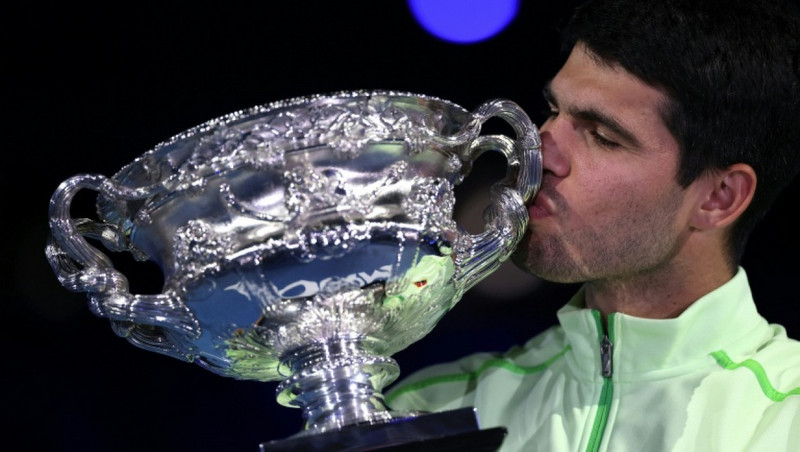
The Spaniard was imperious after a slow start in dismissing the 38-year-old, 2-6, 6-2, 6-3, 7-5 on Rod Laver Arena to claim a seventh Slam title and cement himself as undisputed world number one.
He becomes the youngest man in the Open era to win all four majors, adding to his two titles each from Wimbledon and the French and US Opens.
At 22, he surpassed legendary countryman Rafael Nadal - in the crowd to witness the feat - who was 24 when he did the same.
A seventh Slam put him alongside John McEnroe and Mats Wilander and one behind Andre Agassi, Jimmy Connors and Ivan Lendl.
“Lifting the trophy for the first time in Australia was crazy,” Alcaraz said, before writing on a TV camera lens: “Job finished. Four out of four complete.”
He added: “A dream come true. I dreamt about getting an Australian Open and completing the career Grand Slam.”
He paid tribute to Djokovic.
“You were talking about how I’m doing the things I am, but what you’re doing is really inspiring, not only for tennis players but athletes around the world.”
It was a first defeat for Djokovic in a Melbourne final, having won all 10 previously, leaving him still searching for a landmark 25th major to better Australia’s Margaret Court, who was also watching on centre court.
Djokovic, striving to become the oldest man to lift a Grand Slam singles trophy, last won one at the US Open in 2023. Since then Alcaraz and Jannik Sinner have dominated.
He hinted this could be his last time at Melbourne Park, saying: “God knows what happens tomorrow, let alone in six months or 12 months, so it has been a great ride.”
He also joked with Nadal in the stands, saying: “There are too many Spanish legends. I feel like I was one against two tonight. It’s not fair.”
Fighting fatigue
Both men battled through five long sets in their semi-finals, Alcaraz against Alexander Zverev and Djokovic with Sinner, and recovery was always going to be key.
But they showed few signs of fatigue in another gladiatorial contest.
They both opened with comfortable holds before Djokovic was presented with the first break point chance at 2-1.
Alcaraz saved it, but the aggressive fourth seed kept pressing and converted on his third, then consolidated for a 4-1 lead.
Djokovic was reading Alcaraz’s serve well and once he got in the rallies was authoritative, with a sensational forehand winner earning him two set points.
He claimed the set in a statement 33 minutes, having dominated the big moments.
It was vintage Djokovic, but Alcaraz upped the tempo to break for 2-1 in the second set, pumping his fist when he saved a break point and held in the next game.
Djokovic put drops in his eyes and began rubbing them, unable to tame a now rampant Alcaraz, who broke again for 5-2.
There were some sensational rallies that had the crowd on their feet in set three, which went with serve until Djokovic slapped a forehand wide under pressure to slip 2-3 behind.
He gamely saved four set points at 3-5 but with his energy levels dropping was unable to save a fifth.
On the back foot, Djokovic then saved six break points in an 11-minute opening service game in set four to stay alive.
But Alcaraz ground him down and pounced as Djokovic served to stay in the match to seal a famous win.
It ensured he remained world number one and Sinner two, with Djokovic moving up a place to three.
Stifled emotions
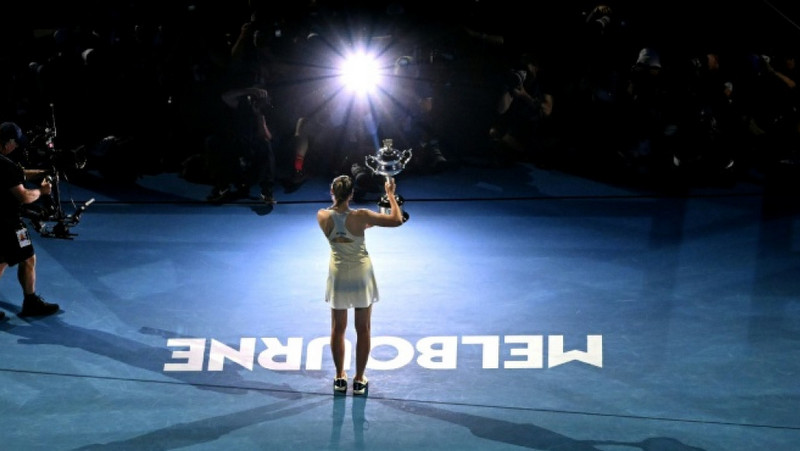
Meanwhile, on Saturday Elena Rybakina stifled her emotions to take revenge over world number one Aryna Sabalenka and win the Australian Open for her second Grand Slam title.
The big-serving Kazakh fifth seed fought back from 0-3 in the deciding set to triumph 6-4, 4-6, 6-4 at Rod Laver Arena in Melbourne in 2hrs 18mins.
It was payback after the Belarusian Sabalenka won the 2023 final between two of the hardest hitters in women’s tennis.
Rybakina, 26, who was born in Moscow, adds the Melbourne crown to her Wimbledon win in 2022.
Rybakina has a reputation for being unflappable but she said she was nervous in losing the second set, even though she did not show it, and again as she served for the match.
She sealed the championship with her sixth ace of the final.
“Well, the heart definitely was beating too fast, even if maybe my face did not show it,” she told local broadcasters. “Inside was a lot of emotions.”
It was more disappointment in a major final for Sabalenka, who won the US Open last year for the second time but lost the French Open and Melbourne title deciders.
She was into her fourth Australian Open final in a row and had been imperious until now.
The 27-year-old top seed had tears in her eyes at the end and draped a towel over her head to hide her feelings.
With the roof on because of drizzle in Melbourne, Rybakina immediately broke serve and then comfortably held for 2-0.
Rybakina faced two break points at 4-3, but found her range with her serve to send down an ace and dig herself out of trouble, leaving Sabalenka visibly frustrated.
Rybakina looked in the zone and wrapped up the set in 37 minutes on her first set point when Sabalenka fired long.
Incredibly, it was the first set Sabalenka had dropped in 2026.
The second game of the second set was tense, Rybakina saving three break points in a 10-minute arm-wrestle.
They went with serve and the seventh game was another tussle, Sabalenka holding for 4-3 after the best rally of a cagey affair.
The tension ratcheted up and the top seed quickly forged three set points at 5-4 on the Kazakh’s serve, ruthlessly levelling the match at the first chance to force a deciding set.
Sabalenka was now in the ascendancy and smacked a scorching backhand to break for a 2-0 lead, then holding for 3-0.
Rybakina, who also had not dropped a set in reaching the final, looked unusually rattled.
She reset to hold, then wrestled back the break, allowing herself the merest of smiles.
At 3-3 the title threatened to swing either way.
But a surging Rybakina won a fourth game in a row to break for 4-3, then held to put a thrilling victory within sight.
Sabalenka came into the final as favourite but Rybakina has been one of the form players on the women’s tour in recent months.
She also defeated Sabalenka in the decider at the season-ending WTA Finals.
Rybakina beat second seed Iga Swiatek in the quarter-finals and sixth seed Jessica Pegula in the last four in Melbourne.
Rybakina switched to play under the Kazakh flag in 2018 when she was a little-known 19-year-old, citing financial reasons.