


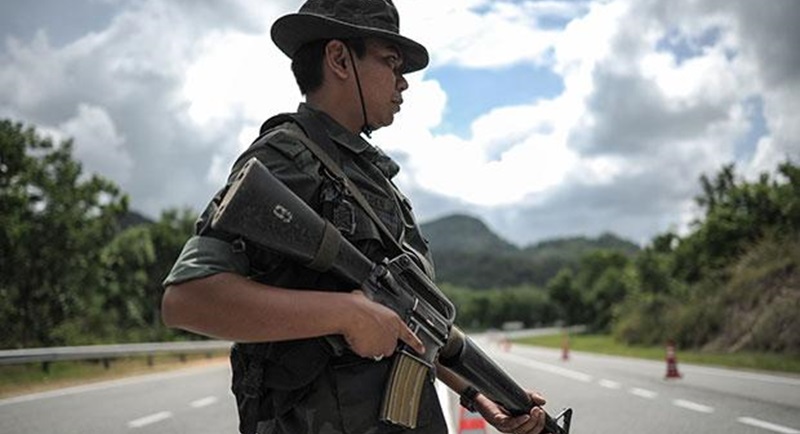
Laying bare the grim extent of the region's migrant crisis, Malaysian national police chief Tan Sri Dato Sri Khalid bin Abu Bakar said authorities were exhuming the remains and it remained unclear how many bodies may lie in the pits, located in a remote and hard-to-reach area of mountainous jungle along the Thai border.
But the findings appeared to indicate a system of jungle camps and graves that dwarfs those found by Thai police in early May, a discovery that ignited regional concern about human smuggling and trafficking.
Thai police today said there were no human trafficking camps left in the South following their month-long crackdown. Earlier, authorities found seven human-trafficking camps on Khao Kaew in Sadao district of Songkhla province.
Monday's discovery in Malaysia follows repeated denials by top officials there – who have long been accused by rights groups of not doing enough to address the illicit trade – that such grisly sites existed on their soil.
"(Authorities) found 139 suspected graves. They are not sure how many bodies are inside each grave," Pol Inspector Gen Khalid told reporters in the town of Wang Kelian near the Thai border. "The also found 28 detention camps."
He said authorities were now exhuming bodies and will conduct post-mortems, adding that at least one body was "badly decomposed."
So far police have provided no details on what caused the deaths.
The number and size of the camps suggest they may have been capable of housing hundreds of people.
Pol Inspector Gen Khalid said the largest could hold up to 300 people, another had a capacity of 100, and the rest could hold about 20 each.
By comparison, Thai police have said they found five secret jungle camps and 35 bodies so far on their side of the border.
But the revelation is likely to focus new attention on Malaysia's record in battling a scourge that activists say is carried out by criminal syndicates, likely with the complicity of authorities.
"I am sure the authorities at the border know what is going on and who the criminals are. The top authorities must be held responsible," said Aegile Fernandez of the Malaysian labour and migrant-rights group Tenaganita.
"I am sure the police know who the criminal syndicates are. It is whether they have the willpower to stop it."
Anti-trafficking groups say the border region near Wang Kelian is widely known to be a key transit point on a route that funnels migrants from Bangladesh and Myanmar into Malaysia and beyond.
Pol Inspector Gen Khalid declined to answer when asked how the extensive string of camps had been built without authorities knowing. However, he earlier said the camps and graves were in rugged areas requiring hours-long hikes to reach.
The US State Department's annual report on human trafficking lists Malaysia on the lowest possible Tier 3, for "countries whose governments do not fully comply with minimum standards (for addressing the problem) and are not making significant efforts to do so.