


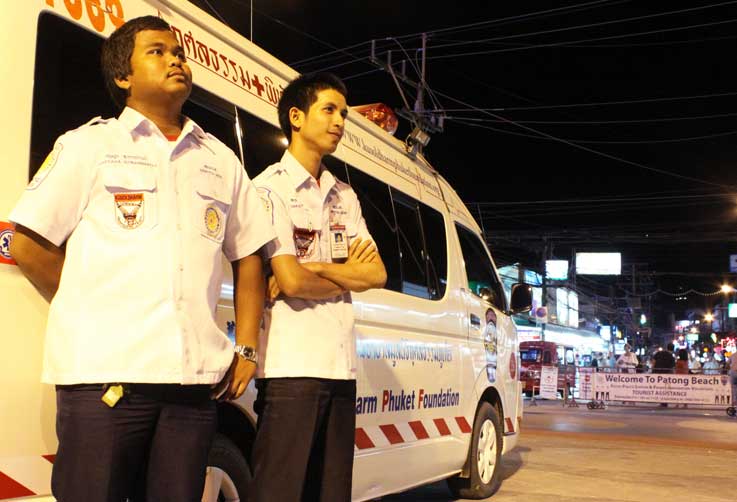
A quiet shift is often interrupted by the ringing of the phone with a call for help on the other end of the line. Immediately the volunteer rescuers of the Kusoldharm Foundation swing into rapid, well-drilled action.
Some are rudely woken from an afternoon nap, some leave their laptops open, and others leave a football game on TV as they quickly scramble into an ambulance or a rescue truck and speed through busy streets, sirens wailing.
With their white uniforms emblazoned with the Foundation’s name in Chinese characters, the rescuers are easily recognised as workers of the non-profit Foundation that has been helping Phuket for more than 30 years.
Kusoldharm began by collecting the bones of nameless dead people and performing the last rites for their spirits, which were believed to be homeless.
"With such an unusual job of ours, people don’t really welcome us with open arms when we visit," said Sangaroon Pakadang, a member of the rescue team who joined the Foundation when he was just 12 years old.
"Some restaurants are reluctant to serve us. Parents of girls don’t want them to hang out with us."
But these attitudes have changed over the decades. More young people are now volunteering to work in rescue teams; over half of Kusoldharm’s staff are 20 to 25 years old.
"We have more than 1,500 volunteers today," Sangaroon said.
"But I can tell you that if you want to get involved only because you want to be cool, you won’t be working with us for long."
While most of the foundation’s workers are unpaid volunteers, there is a core staff of 50 workers who are paid small salaries from some of the donations the Foundation receives.
Work as a Kusoldharm volunteer would terrify most people; blood, horrific causalities at accidents, and the stink of corpses are a part of each day for a volunteer.
"I can still remember the shock of my first rescue mission," said Kritsada Suwanroj, 18, who has been a rescuer for a year now.
"I had to move the body of a foreigner who had been dead in his room for many days."
Sakul Nabnian found it difficult to deal with rotten bodies while moving the remains of 13 corpses from a cemetery.
"The very first mission for a rescuer is when he has to conquer the fear of the frightful scenes he will be facing," Sakul said.
But why do they choose to encounter that fear at the beginning? Why do they enjoy the risk of being rescuers?
One answer was provided by Wirut Jaiton: "because I never see it as a job; it’s a part of my life."
Some rescuers join the team because they find themselves addicted to helping people. Others are involved because they seem to have found a second home at the foundation.
"I wanted to be a doctor because I wanted to help people," Wichian Khaosaad said. "But my family could not pay for my medical studies.
"I saw the rescue teams working hard in areas hit by the tsunami in 2004. I saw them giving first aid to casualties and I figured out that I can help people too even though I’m not a doctor. Actually, survival depends on good first-aid as well," said Wichian.
"I was impressed by the Kusoldharm rescue team who picked up the injured and a body on the road in front of my shop. So I spent my time after work as a volunteer for them,’’ Sakul said.
"Once I helped carrying an old lady and she wai to me to thank me. I was overwhelmed and I became sure that I was doing the right thing. Then I decided to join the rescue team permanently."
Sangaroon said "we also perform rituals for anyone who needs them, such as checking on Feng-sui, house-warming and arranging requiems. It gives people psychological help. The foundation can remain if people have faith in us."
The nature of the work means it can be extremely emotionally draining on volunteers.
"Once I was sent to rescue a Korean tourist who was dragged by the wheels of a truck. Badly-wounded, she was screaming with pain. It was the first time that I felt helpless because there was nothing I could do for her," Sangaroon said.
Though despite their work, there are some complaints from the public about the Foundation, especially about the high speed of their rescue vans.
"Many complain that our driving is dangerous to other vehicles. But a minute could mean a life, that’s why we want to get to the injured as fast as we can," Wirut said.
Kusoldharm staff are trained hard in a variety of skills, such as driving, providing first-aid, and diving. Personal adaptability is essential, as the work ranges from rescuing a drowning dog, to catching a snake, to performing the correct religious rituals for the dead.
"You may be a billionaire, but you may not be real happy if you don’t have a chance to help people," said Supachai Limpakornkul, with the foundation since 1985.
"When you help people, your life is better."