


This video, captured by a car dashboard-mounted camera and posted to YouTube by user Andrey Korolev, shows a fireball appearing in the morning sky and brightening as it streaks over the Chelyabinsk region, east of the Ural Mountains.
Light from the object floods the landscape and suddenly intensifies, apparently when the object detonates in mid-air.
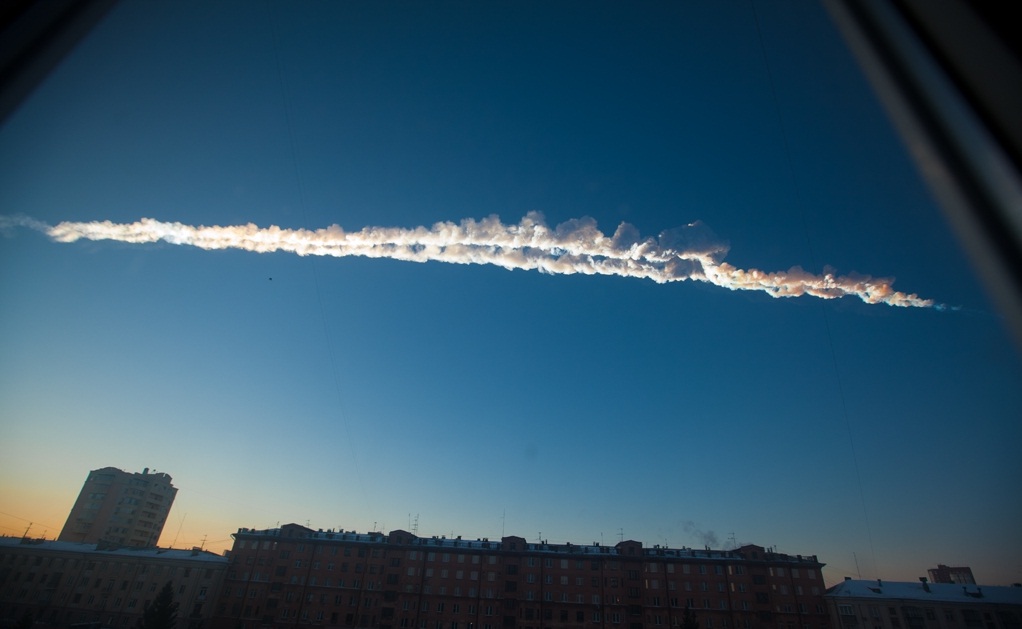
Other online videos from the region show a sky streaked with vapour trails from the unidentified object, which is thought to be a large meteor or a piece of space junk.
Debris from the explosion rained down on parts of central Russia, sowing panic as the hurtling space debris exploded in the air, blew out windows and left several people injured, officials and agencies reported.
Television footage showed morning traffic grinding to a quick halt in the city of Chelyabinsk as a blinding flash lit up the blue sky, causing some to huddle in buildings for safety.
A medical source said that 100 people came to hospitals for medical treatment, while the emergencies ministry confirmed that cellular telephone communications were temporarily cut.
"A meteorite disintegrated above the Urals (mountain range in central Russia), partially burning up in the lower atmosphere," the local office of the national emergencies ministry said in a statement.
"Fragments of the meteorite reached Earth, falling in sparsely populated areas in the Chelyabinsk region," it said.
Officials said a part of the meteorite fell 80 kilometres (50 miles) from the town of Satki, itself 100 kilometres west of the regional centre.
Schools were closed for the day across the region after the impact blew out windows of buildings and temperatures had plunged in central Russia to -18 degrees Celsius (0 degrees Fahrenheit).
Most of those injured were treated for minor cuts and bruises from shattered glass, the local police department told the RIA Novosti news agency.
The Chelyabinsk region is Russia's industrial heartland, filled with smoke-chugging factories and other huge facilities that include a nuclear power plant and the massive Mayak atomic waste storage and treatment centre.
A spokesman for Rosatom, the Russian nuclear energy state corporation, said that its operations remained unaffected.
"All Rosatom enterprises located in the Urals region -- including the Mayak complex -- are working as normal," an unnamed Rosatom spokesman told Interfax.
The emergencies ministry said radiation levels in the region also did not change and that 20,000 rescue workers had been dispatched to help the injured and locate those required help.
The defence ministry meanwhile said it had sent soldiers "to the sites of impact."
Footage of the incident broadcast on state television showed at least two bright flashes fill the sky at around 9:00 am (0500 GMT) as the streets filled with morning rush hour traffic.
Amateur footage posted on YouTube showed local men swearing in surprise and fright, and others grinding their cars to a halt.
"At first I thought it was a plane," one man told Russian state television. AFP