


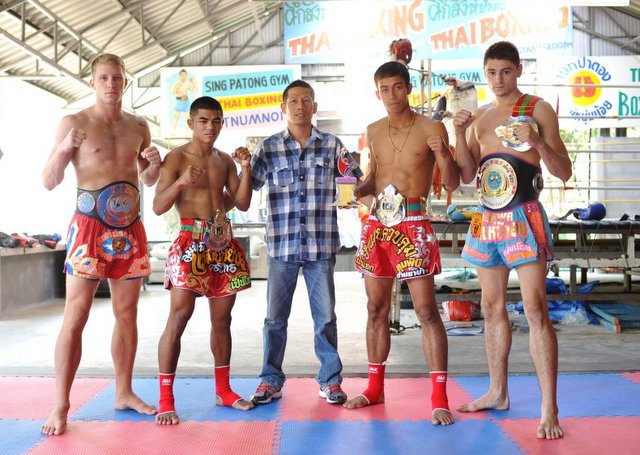
Most passing motorists probably don’t give it a minute’s thought, but if they did pause they might be able to make out the small sign which says simply ‘Sing Patong’.
This translates as ‘The Lion of Patong’, and this Muay Thai camp has been roaring louder than any other in Thailand in recent months after taking three young men and transforming them into world renowned fighters.
Penthai Sitnumnoi, from Krabi, Peneak Sitnumnoi from Phattalung and Damian Alamos from France all hold titles at Lumpini Stadium, the most coveted in the entire Muay Thai world. Peneak is also the reigning fighter of the year.
Muay Thai is the national sport of Thailand, and thousands of young men aspire to the sort of success that will bring glory and more significantly, because few, if any, come from affluent backgrounds, money.
Every year the best fighter in the entire country is crowned and at the end of 2011 that prestigious accolade went to Peneak.
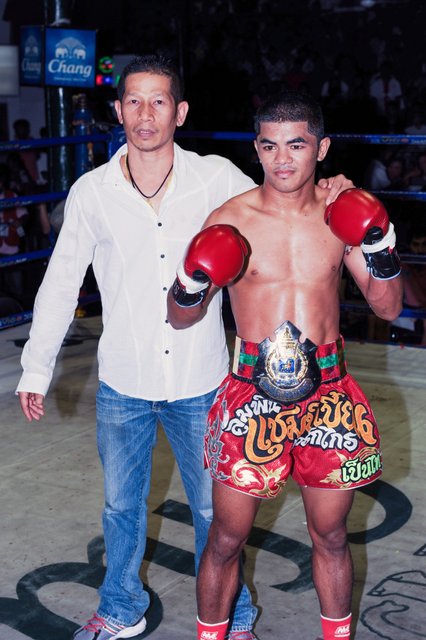
It is unusual for fighters based in Phuket to make such an impression on the Bangkok stadium scene, and Sing Patong’s success is largely due to the softly spoken and humble manager and head trainer Somnuck Padburee, or Num Noi as he is more commonly known.
Originally from Phattalung, he has been in Phuket for a decade and has helped the likes of Peneak and Penthai go from being aspiring young fighters to becoming two of the most recognisable ‘Nak Muay’ in all of Thailand.
While Sing Patong’s fighters have been in the spotlight in the last six months, Num Noi is anxious to point out that this success did not come overnight.
“Sing Patong was founded in 1971 by Somsak Junlaka, my boss, and it is the only camp in Thailand which has three Lumpini champions now and Damian is also the only foreigner to hold a Lumpini belt.
“Peneak was voted the best fighter in Thailand recently, he is 22 and has been training with me since he was 12 years old.
“For his first fight he got B200 or 300, but now he gets at least B100,000 for a fight.”
Damian is the most successful of the foreign fighters at Sing Patong at present but there are a number of others from as far afield as Australia, England and France including WPMF Champion Charlie Peters.
While the ‘farangs’ and the Thai fighters train side by side the focus, according to Num Noi, is very much on local talent.
“We have about 15 Thais. The younger ones all go to school so they don’t train hard in the morning, they just go running and then after school they train hard.
“Some of the boys go to school on Saturday and Sunday and train during the week.”
While the foreign fighters pay around B8,000 per month to train at Sing Patong and tend to live outside the camp, the Thais all stay together and their food, accommodation and education is taken care of.
In return the camp is entitled to 50 per cent cut of a fighter’s purse, although Num Noi is very laidback about money and says he often chooses to take less.
As you would expect from a group which comes predominantly from Southern Thailand, they are a mixture of Buddhists and Muslims but in the relaxed atmosphere of Sing Patong this doesn’t create any difficulties.
“They do not always eat the same food but apart from that everything is the same.
“When they are fighting they are expected to train hard for 15 days but after the fight they can relax.
“I don’t mind if they have girlfriends and sometimes we all play cards together.
“It’s not strict, but I don’t allow them to drink or smoke.”
While Peneak is not exactly a household name in Phuket, in his hometown of Phattalung it is a very different story.
Almost 10,000 people turned out to see him fight former Lumpini Champion Saketdao Petphayathai on a school playing field their recently, with the gate taking almost B5 million.
It was a momentous occasion in what is normally a sleepy Southern town, and the place was absolutely packed with some spectators having to settle for watching the action on two big TV screens set up at opposite corners off the field.
Alamos had originally been scheduled to fight but pulled out after a family member fell ill, but that still left two of Sing Patong’s fighters on the card with Penthai facing the more experienced Palongpon Watcharachaigym for the WPMF flyweight belt.
The fighter from Krabi came out strong in the early rounds, looking to make amends after having already been knocked out once by the same opponent.
Palongpon came back in the all important third and fourth rounds causing a desperate gambler to offer Penthai a cool B50,000 to turn the fight around.
In the final round he came out all guns blazing and cut Palongpon open with an elbow as the crowd urged him on, but it was too little too late and all three judges awarded the decision to the Bangkok-based fighter.
It was almost midnight by the time Peneak made his way into the ring for the main event, which would also be for a WPMF title.
Before the battle commenced it was announced that the dignitaries in attendance had decided to award him a B10,000 bonus for his elaborate Wai Kru, the pre-fight dance which all Muay Thai fighters perform.
After winning titles at both Channel 7 Stadium and Lumpini Stadium, opponents are understandably reluctant to face Peneak and he has had to move up in weight.
As a result, Saketdao looked bigger and stronger and was able to dominate the Phattalung native in the all important clinch.
As if the presence of 10,000 fans in his hometown wasn’t enough, Peneak was offered a B50,000 tip to turn the fight around at the end of round three, and by the start of the fifth round this had risen to B150,000.
He gave his all in the final three minutes and many in the crowd thought he might just have done enough to overtake Saketdao on the scorecards but all three judges ruled against him.
It was disappointing for the 22 year-old, who at least had the consolation of receiving a career high B150,000 purse for the fight.
Muay Thai stadiums are, along with horse racing tracks, the only place in Thailand where gambling is legal, and if a gambler feels they are in danger of losing a significant bet they will often try to alter the course of the fight by offering the fighter they have backed a big tip if they can come from behind to win.
Penteak says B150,000 would have been by far the biggest tip he had ever received in his fighting career, and is sorry he could not do enough to overhaul Saketdao’s lead on the scorecards in the latter stages of the fight.
“The biggest tip I have ever received from a gambler before was at the Channel 7 Stadium when I fought for the title there and I got given B20,000.
“I tried my hardest to win because I knew I was behind in the final round but he is very strong.
“I am happy that so many people came to see me fight and I hope to fight in Phattalung again next month.”
Num Noi is himself a Phattalung native and is happy to be able to bring some of his best boxers to compete in his hometown.
However he does not feel there is much chance of an event on this scale ever taking place in Phuket.
“At the stadiums in Phuket it is mainly foreigners, there are not so many Thais so I don’t think you could ever get 10,000 people turning out to a Muay Thai event in Phuket.
“When my fighters start out they will fight in Phuket, but once they win a lot of fights and are successful I send them to Bangkok to fight because that’s where the best fighters are.”
Num Noi says Sing Patong does not have an active website and has never advertised but still attracts a steady flow of foreign customers due to its excellent reputation.
It also receives regular coverage in the Thai media where it is more commonly referred to as the ‘Sit Numnoi’ camp.
In 2012, Sing Patong celebrated its 42nd year of existence in some style: February saw Alamos win the Lumpini Super Lightweight title, in March Penthai became flyweight champion in the same stadium and the most magical moment of them all came in July when Peneak deposed arguably the top fighter in all of Thailand, Sam-A Gaiyanghadaogym, to take the featherweight title.
While Peneak, Penthai and Alamos currently sit at the pinnacle of the sport there is an entire generation of hungry young fighters just waiting to knock them off their perch.
Success in such a competitive sport is difficult to obtain and even tougher to sustain but ‘The Lion of Patong’ is currently king of the Muay Thai jungle.