


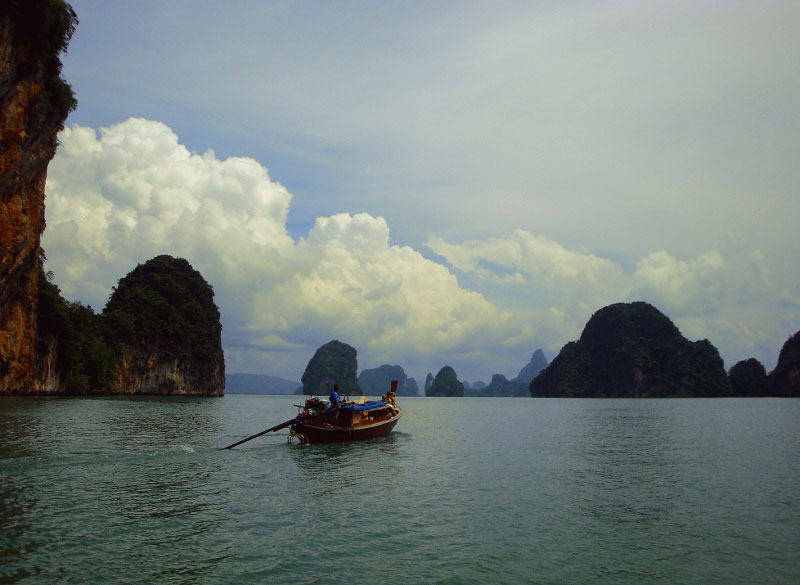
Close to Phuket, fees will go up for entry into Khao Sok National Park; Than Bokkhorani Marine National Park, Mu Ko Lanta Marine National Park and Haad Noppharat Thara-Phi Phi National Park, all in Krabi, the Similan and Surin Islands; and Phang Nga Bay National Park.
TTR Weekly reported today (August 24) that fees for Thais to visit most parks will rise from B40 to B100 for Thais. In the case of the Similan and Surin Islands, the rise for Thais will be from B80 to B100.
For foreigners, the rise will be from B200 to B500, except for the Similan and Surin Islands, Lanta and Haad Noppharat Thara-Phi Phi, which will rise from B400 to B500
Initial reaction from inbound tour operators and dive companies to the size of the rise and the short notice has ranged from resignation to anger.
A Phuket-based dive operator who asked not to be named, told The Phuket News that better protection for parks was always a good thing. “Everyone realises that something has to be done to protect the environment. We’re all for that.”
But, he said, transparency is an issue. “We still see fishing nets at Hin Daeng [a prime dive site in the Koh Lanta Marine National Park] and fishing boats go there in the low season. Is anything going to be done about that?
“To justify a rise of 150 per cent is pretty difficult when no one knows what they are doing with the money.”
For dive companies the new fees are not too hard to absorb; liveaboard trips can cost tens of thousands of baht a day, so adding another B100-300 will not cause problems.
But for mass tourist operations with fixed contracts already signed for the coming year – such as some of the sea canoe companies taking tourists into Phang Nga Bay – the rise is shocking, especially when they will not be able to pass the hike on to their clients.
TTR Weekly quoted the managing director of Nutty Adventures and Ayutthaya Boat and Travel, Nithi Subhongsang, as saying that the announcement had come as a shock and would have a “horrible impact on inbound tour operators” because contracted prices are signed for the entire year and the ones for next year are effective until October 2013.
“I cannot accept this and I will file a complaint,” he said. “It is ridiculous, a 150-per-cent hike. How did they calculate it?
“Officials are never transparent, and there is no guarantee that the budget will be used for what they say it will. They have to show us why they need the extra income … Private stakeholders have never been called for a discussion or given a heads-up on this in advance.”
Not all of the mass operators have been caught out in this way. Sakwuth Udomsrisak of Phuket Adventures learned from a controversial fee hike five years ago. He told The Phuket News that his contracts include clauses that allow the company to charge more if there is a sudden hike in park fees.
The department claims the top national parks are suffering from too many tourists and the new fees will be a deterrent to help fight deterioration of a sensitive environment. Also, the department says, it will use the additional revenue “to improve facilities to better serve tourists”.
Park fees were last raised five years ago, also at short notice, causing a storm among mass operators. The DNP had to back down and make concessions. This time, director-general, Damrong “the Demolisher” Phidech, said that if there are complaints about high price, the department might consider a revision.
“These new fees are based on the principle that people need to make sacrifices to conserve natural resources,” he explained.
National Park Office director, Wittaya Hongwiangjan, said that normally the department allocated B10 million to each national park, but the money was used for patrolling and looking after resources, with none left for services such as expensive treatment of waste water generated by tourists.
The hikes, if they go ahead in their current form, should bring another B430 million into DNP coffers, or about B3 million per park.