


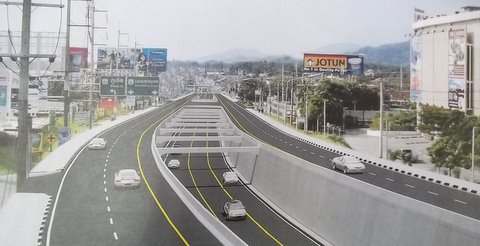
Speaking at an informal public hearing at the Wichit Municipality offices, Professor Amnart Tantitamsopon explained, “The intersection is in low land and there was once a tin mine in the area. ”
He questioned the four-man panel – two from the contractor and two from the Highways Department – about details of soil testing that had been undertaken.
“Phuket sometimes has earthquakes and it rains here very often,” he said. “It’s difficult to know for sure whether the land [around the underpass] will collapse or not.”
Panel members Ittiwat Kritsanawanit, the project engineer, and Narong Horee, the project manager, from contractors Italian-Thai Development Co, assured the meeting that all the necessary soil tests had been done, and pointed out that the company had built similar underpasses in Bangkok and Chiang Mai, with no problems.
Prof Amnart responded that the success of the previous contracts was no guarantee because the soil conditions and land structure are very different in Phuket. He urged them to ensure that very comprehensive studies be undertaken before construction begins.
The professor, who runs a geology practice in Phuket, explained later to The Phuket News, “The soil in that area is a mixture of granite and sandstone.
“I would like to know more about the underground strata. What rock will be under the underpass? How heavy will the underpass be?” These things were not made clear at the meeting, he said.
Apart from Prof Amnart, the hearing drew a mix of local people along with representatives from the Traffic Police, local government officials, and a teacher from the Darasamuth Phuket School, which is right next to the intersection.
Most of the people at the meeting were in favour of the underpass, though there was some dissension from people living in the area.
One said, “Perhaps this will not solve traffic problems. Phuket is too full of cars, and people drive with no respect for the rules.”
Instead of building underpasses, he said, “We should find measures to reduce the number of cars in Phuket.”
The project is the first of three. It will be followed by an underpass at the intersection next to Tesco-Lotus, costing B850 million, and then another underpass at the Bang Ku intersection at the north end of the bypass, costing B500 million.