


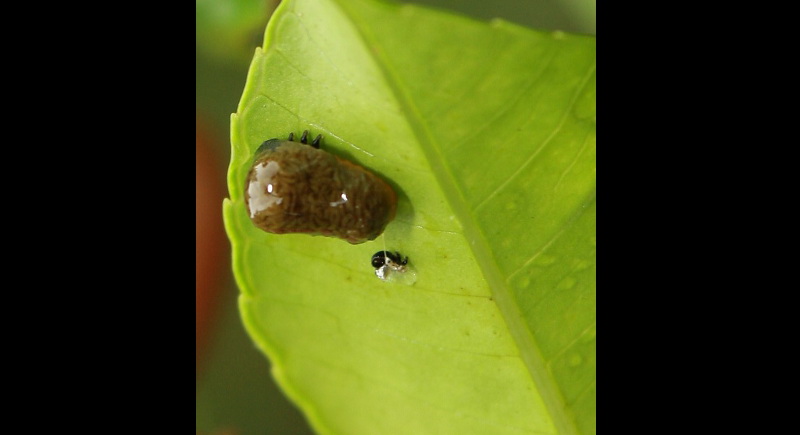
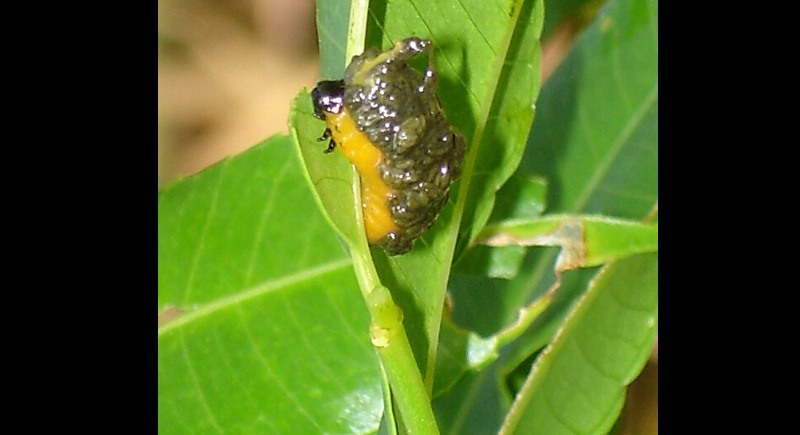
But carrying one’s excrement on one’s back is, some people might think, taking things a bit far.
We recently bought a makok tree, sometimes known as Thai olive. The fruit bears a passing resemblance to olives, but that’s as far as it goes. In fact this tree – Linnaean name Spondias dulcis – is a relative of the cashew tree.
The fruit, crunchy and a bit sour, is a favourite with Thais. According to some theories, Bangkok started off as “Baan Makok”, or Makok Village.
This tree came complete with its own complement of leaf-eating bugs. The image is pink and black and looks quite like a ladybird, but it isn’t because ladybirds are carnivorous and these bugs are leaf-eaters.
When you examine the underside of leaves that have been nibbled, what you find is a small blob of shiny dung. Definitely unappetising if you’re a bird. Nope, I don’t think I want to eat that.
But scrape the dung off gently and underneath you find a fat grub, bright yellow with black feet and head.
Contemplate the Darwinian route whereby this grub ended up doing this. Momma lays a bunch of eggs that hatch into bright yellow grubs that birds can see easily and eat. Not exactly the fittest for survival.
But one of the brood – let’s call him Frank – simply can’t get the hang of wiping his bottom. In fact, he gets crap all over himself.
Momma thinks this is disgusting, but as he grows, all his cleaner, brightly-coloured siblings get gobbled up, until there’s only Frank left to pass on the family genes.
His girlfriend Thelma is none too happy with his grubby habits but since Frank’s the only kid on the block, she has no choice. Mate, mate, mate, lay eggs, lay eggs, lay eggs.
And half of the kids grow up with Frank’s horrible habit. But they survive. Those with Thelma’s ability to use toilet paper don’t. See how this goes?
This article first appeared in the blog Garden In Siam. To read other articles, go to
http://gardeninsiam.wordpress.com