


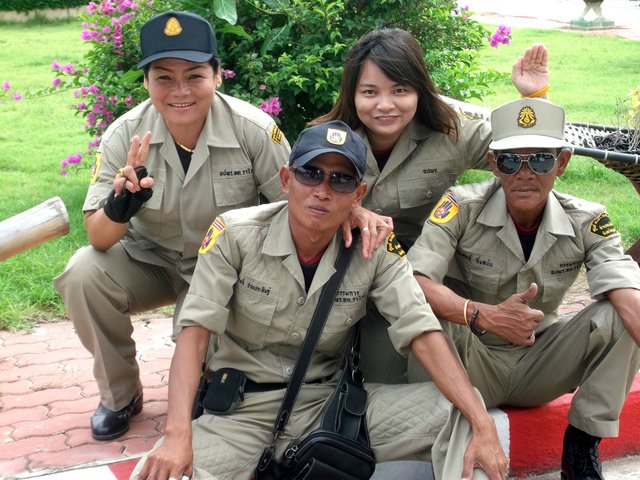
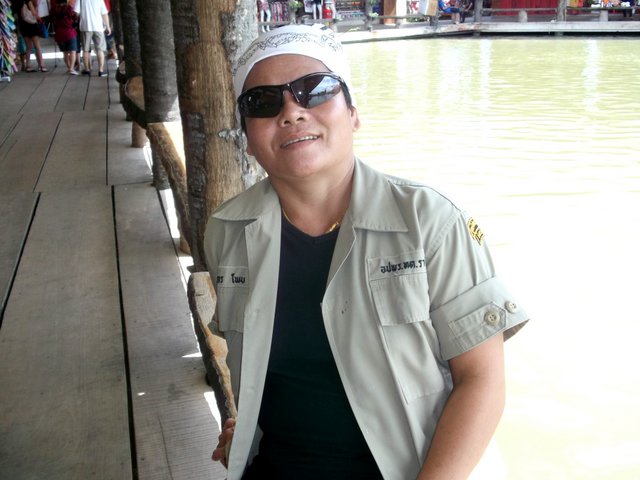
But in every community is an important group of volunteers quietly helping: the Civil Emergency Relief Division (CERD), known to Thais as the OrPorPorLor.
The CERD volunteers are ready to help, whatever the threat, whether it be another tsunami, or a bag snatcher lurking in the area, flooding from a monsoon downpour or a nasty road accident.
The island’s growing population and proliferation of construction sites means more and more people and structures are at risk in one way or another.
In many cases the first to provide assistance are the CERD volunteers. They live locally, and are usually on the scene before the police or any other authorities.
For this, they need to be highly trained to handle any situation.
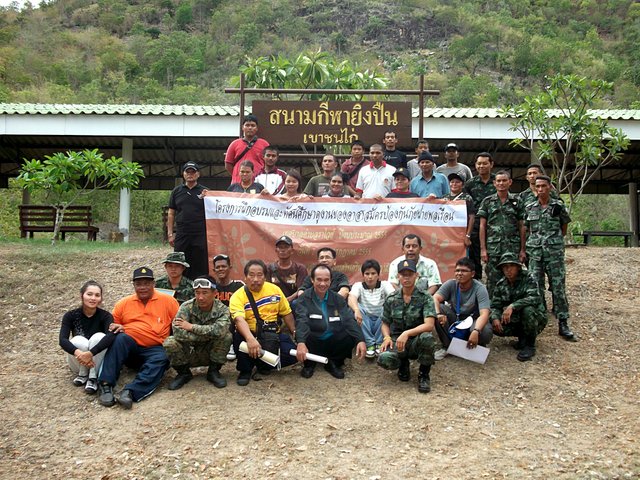
Gunapon “Mieal” Pope, 53, from Rawai, was one of 50-odd volunteers from around Phuket who went to Khao Chon Gai, in Kanchanaburi Province, at the beginning of June for a week of intensive training by the Royal Thai Army.
She explains that this particular course included everything from marksmanship and crowd control to parachuting. It also included basic criminal investigation techniques. and ways to collaborate with police to arrest criminals.
“The training was the same as soldiers get, because they have to make sure that the volunteers can handle any dreadful situation or emergency.”
Ms Gunapon has been a CERD volunteer for six years, though she had already spent much of her life before that helping people in her community.
“I love to help people, including poor children and women in trouble. I also like to help preserve the environment,” she said.
Since joining the CERD, she has been on a variety of courses every year. These have been aimed at preparing her and her fellow volunteers to handle just about any situation as it arises.
In addition to guns and parachutes, Ms Gunapon is now trained in disaster prevention; in disseminating information to the press and public; in coordinating with government agencies; and in recording criticism of the civil defence system and ensuring that it is passed on to the right quarters for action and improvement.
She has also been trained in more mundane aspects, such as keeping records, budgeting, accounting and management of inventories.
Major responsibilities of the CERD include drawing up plans for any emergency in their area, and organising training for their members on disaster prevention.
Volunteers also gather statistics about the local community and make them available in a form that can be used by the government or the public.
Being the first responder for disasters in its area, the CERD coordinates with government agencies and the private sector, and is also equipped and trained to be a clearing house for reports and other information in the case of disasters.
This allows them to determine which government agency should manage which issue, and how to handle media enquiries and get information out to the public.
Ms Gunapon’s main duty in Rawai is administration – but she says she is always ready to jump in and help with anything else that needs doing.
For example, she says, Rawai is a high-risk area for criminal activities. To help combat this, the training in Kanchanaburi included signs to watch for that may indicate a crime is about to take place.
In such a situation, team members can be reached by walkie-talkie and called in to keep an eye on a suspected thief or troublemaker. The radios are, of course, also essential in the case of accidents, and for coordinating with police.
The Rawai team has about 30 volunteers, but you probably won’t see them during the day; they normally work in shifts from 10pm to 2am, though if they are involved in handling a situation they will stay until it is resolved. They are also on standby 24/7 in case of major disasters.
Volunteers get a uniform from the CERD – if they want more than one, then they have to pay for it themselves.
Ms Gunapon says it is important that they wear uniforms, partly because it is easier to get cooperation from the public, but also so that the police, in a confused or possibly violent situation, can tell the volunteers from the bad guys.
There’s little glory in the job, very little money, much lost sleep, and quite a bit of risk. But for the volunteers the compensation is the immense satisfaction they get from doing something good, not just for themselves, but because it’s the right thing to do.
Making a difference
The rewards for being a CERD volunteer are definitely not financial – they get a stipend of just B59 a day.
But the CERD is convinced that there are many people who would be happy to do this work for the good of the community – and that includes foreign volunteers.
As Thawatchai Thongmung, Deputy Mayor of Phuket City, points out, the community and environment are constantly changing, in ways that often increase hazards.
“Terrible things can happen, damage to lives and property. Government officials and police alone are not enough to take care of everyone living in Phuket,” he says.
“Maybe someday, you will be in an accident, and this group [the CERD volunteers] will be the first people to help you. They never do this for themselves; they do it for the good of others.”
For anyone interested in volunteering, the next initial training course is to be held from August 6 to 10.
Volunteers (who may be Thai or foreign residents) should apply by next Monday (July 30) to the CERD office at the Department of Disaster Prevention and Mitigation on Kra Rd in Phuket Town.