


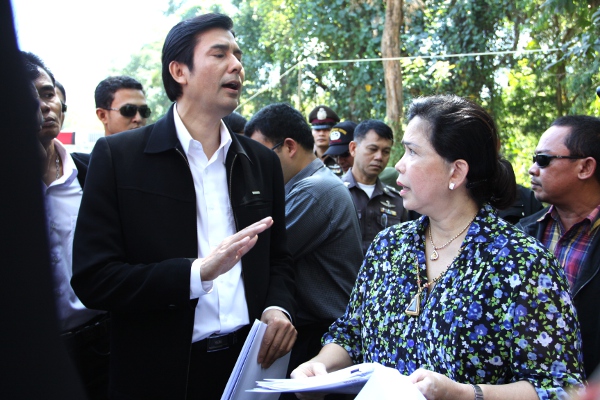
A commission of the National Anti-Corruption Commission (NACC), consisting of MPs, visited the land to collect more information in the second such point-and-shoot-your-mouth-off exercise in a matter of weeks,
Among the visitors was Prompong Nopparit, Pheu Thai Party spokesman and a vice-president of the NACC, who visited the land a month ago and declared the title deeds “suspicious”.
He said at that time that he suspected that as many as 11 bureaucrats, including a former governor of Phuket, were involved in taking bribes to issue the deed.
Yesterday, however, the couple who claim ownership of the land, Benja Sawetwaan and Eakchai Sae’ew, turned up and insisted the land was theirs and there was nothing wrong with the deeds.
Not only that, said Ms Benja angrily, “Our reputation has been badly damaged by this investigation. We are victims of society.”
She said she believes that the investigation is part of ongoing “persecution” inflicted by people “who failed to grab the land”.
Claims have been made that the current Chanote deed for the land is not based on an original Sor Kor 1 paper, and that at least part of the land is in a protected forestry area.
But at a meeting at Phuket Provincial Hall yesterday, the couple said that they had bought the land from the Wutthithamaporn family, who had occupied it since 1937. Key dates in the chronology of the land:
- 1937: Prateep Wutthithamaporn takes possession of the land.
- 1954: Thailand’s current land laws are promulgated. Anyone wanting to confirm possession right to land and to receive a Sor Kor 1 occupation paper must apply to the authorities. However, the land owner at the time, Prateep Wutthithamaporn, shows no interest in talking to the authorities.
- 1973: The first preserved forest areas are delineated.
- 1977: Prateep's son Thaweep objects to the establishment of a preserved forest area overlapping his land, stating that he has occupied the land since six years earlier, ie 1971.
- 1978: The government begins an official survey to issue land papers to any owner who has missed out in earlier rounds, but fails to survey the Freedom Beach land. Thaweep follows his father’s example and ignores this.
- Sometime before 1990: Pantong Na Ranong signs a contract to buy the land, paying in installments.
- 1990: Pantong applies for a title deed. Later, however, he misses an installment and because of the conditions of the sale contract, forfeits any rights to the land
- 1997: Ms Benja and Mr Eakchai buy the land from a daughter-in-law of Thaweep. Pantong is still involved in the application for the deed, as he started the process.
- 2010 (April): A full chanote title for the land is issued.
Because there was no proof that the original land owner had requested a Sor Kor 1 in 1954 or 1978, Mr Prompong and the NACC suspected that the current title deed for the land might have been obtained through corruption.
Mr Prompong pointed out that neither a Sor Kor 1 nor any papers relating to the issue of a Sor Kor 1 had been found, which was what led him to believe that some officials might have been involved in legal sheninigans.
Though Ms Benja failed yesterday to clarify this point, she claimed that a number of relevant authorities, including the Administrative Court, had investigated the case and had come to the conclusion that the land was eligible for a title deed.
Mr Pompong earlier pointed out that much of the site consisted of land sloping at more than 30 per cent. Under the 1954 law, no one may occupy or claim ownership of land this steep. This, he said, was another indication that the land deed was dodgy.
However, when the 1954 law came into force, it allowed for title deeds that included steep land provided that the claim to the land had been made before 1954. This, Ms Benja said, was the reason her chanote covered even land with a slope of more than 30 per cent.
The NACC commission decided that it will conduct further investigations.