


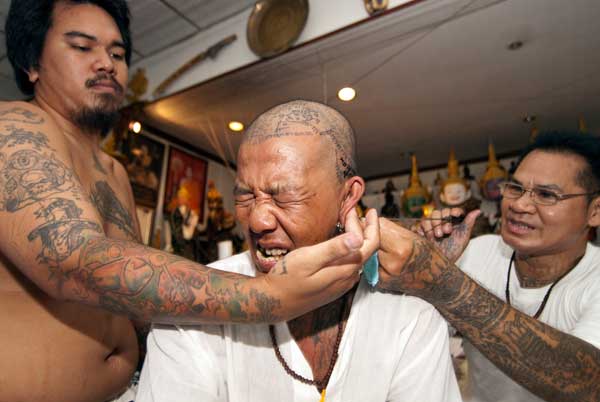
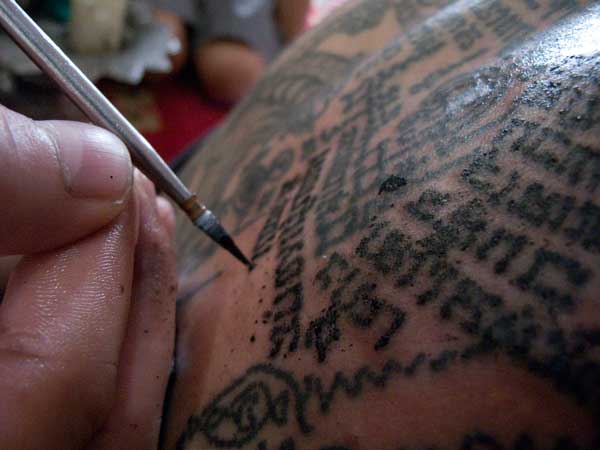
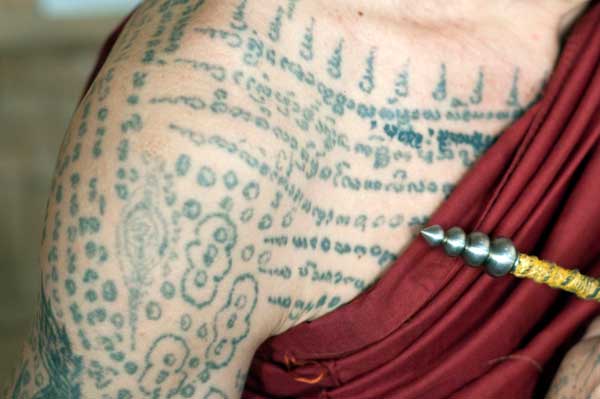
It is a sacred Thai tradition shrouded in mystery; magical tattoos, said to give the bearer tremendous power.
And although it is beautiful, this is an art form that goes far deeper than the skin.
Once a symbol of manhood, and in more recent times relegated to a symbol of the criminal classes, sak yan is
making a resurgence in Thai popular culture, and gaining increasing global interest.
And given the resurgence of this ancient art, it seems fitting – if unprecedented – to have two detailed publications on the topic released in English late last year.
The most recent, and more comprehensive of the two, is Sacred Tattoos of Thailand, the lovechild of Lonely Planet Thailand author Joe Cummings and photographer Dan White – a 200-page lavishly illustrated hardback book exploring the tattoos’ origins and meanings.
But beyond the aesthetics, Joe’s words, and Dan’s images, take us into the magical world of sak yan tattoos, uncovering the spiritual beliefs that makes it such a potent force in Thai society.
For Joe, the mystical skin art has been a subject of intense fascination since he first arrived in Thailand more than
three decades ago.
“I came to Thailand a long time ago, in 1977, and my main motivation was that I studied Buddhism... I remember hanging out in temples and once in a while I’d run into these monks with these weird tattoos, and I always wanted to know more about it,” he recalls.
“Over the years I learned a little bit here and there... but a couple of years ago I just
decided to dive right in all the way,” Joe says.
And dive right in he has – his work is arguably the most comprehensive published on the subject in any language, let alone English.
Fact from fiction:
Literate in Thai, Joe says he has read the bulk of Thai material available on the subject – fewer than a dozen publications – but found almost all of it distorted by sensationalism and myth.
“It’s not well explained in Thai or English. At first I was just talking to people, interviewing people, and just between all the masters and disciples, the stories didn’t quite line up for me.”
And so, while balancing his job at the Bangkok Post, Joe spent about 18 months researching the book, travelling around the various provinces of Thailand, and also into Laos and Cambodia, in search of answers.
The research process was by no means easy; there is no comprehensive database of practising sak yan masters, and most of the time, Joe had little more than the name of a town to go by.
Once in a town he then had to find the location of the samnak, the place where the
masters perform their tattoos.
Even when he found them, uncovering the mysteries within was no simple task.
“The biggest challenge was winning [the masters] over so that they could actually talk to me openly, and give me enough information that I could actually say something. Even if they were not openly distrustful, they were just sort of withholding, because these are their trade secrets in a way,” Joe says.
“Then it’s a matter of gaining his trust so he’ll actually talk to you because they’re pretty distrustful of outsiders and especially foreigners. It helped that I spoke Thai, but I had
to do more than that.
“Besides that, there was so much contradictory information. One master would say one thing, then another would say something different. Then I had to try and reconcile that. That was a big challenge.”
But as Joe got on the road a little more, and met with more masters, he began to formulate a broader understanding of sak yan, and it became easier to talk to others.
In the end, the hard work and frustration has paid off, with his book drawing some unique and insightful conclusions, and perhaps most pertinently, a comprehensive history of how the art form evolved and spread through Thailand and elsewhere in Southeast Asia.
“The main purpose of these things [sak yan] is not actually the way they look. Not even what the purported power is, but the actual moral code that goes with it... It is a way of containing Buddhist morality in Thai society…that’s the one thing that links all of the masters and all of the traditions,” Joe says.
“You’ll have to read the book though, because it’s pretty complex.”
The book begins with a general introduction before delving into the history of sak yan, tracing the spiritual art form from Thailand back to its roots in the Tai cultures of southwestern China and northwestern Vietnam. It profiles different masters and disciples, and explains about 40 different individual spells, or yantra.
But Joe’s words are only half the story.
The accompanying photographs by Dan White, another longtime Thailand correspondent, deliver a broad showcase of sak yan art, from elaborately etched bodies to full monastic rituals, which capture the essence of, and also show great respect, to the tradition.
“[Getting the images] was very difficult. Again, it was the trust factor. Once I got them to trust me as a person interviewing them, then I also had to get them trusting the photographer,” Joe says.
“Dan did a remarkable job. I think it was stressful for him, and yet he stepped up to the plate.”
That often involved many hours waiting outside in the searing sun while Joe was inside interviewing the masters.
“Sometimes he just had a split second to capture something very transitory, some action… and I think he did a great job in capturing these instances that an ordinary photographer would have missed, for sure.”
Times are changing:
Once, sak yan was a symbol of manhood, a rite of passage for young Thais. More recently, the perception developed
that it was a symbol of the criminal class – a form of protection worn by those whose lifestyle involved violence.
Joe believes this evolution was partly due to growing Western influence over the past 50 years, which led to the “repression” of tattoos in Thailand, when it became seen as inappropriate for those in higher levels of society to be tattooed.
“I don’t think it’s so true any more, not any more, thanks to the Angelina phenomenon,” Joe says, referring to movie star Angelina Jolie, who famously had the yan haa thaew tattooed on her left shoulder blade back in 2003.
“It’s undergoing an extraordinary revival now, thanks to Angelina. That made it like ‘OK, this rich glamorous
Western woman thinks it’s cool.’ Now all levels of Thai society are interested.”
But like any tradition, popularity does not always amount to positive outcomes.
“I think it’s a double-edged sword,” Joe says. “By bringing attention to it, it’s helping preserve it. And then of course it’s bringing profit and motive into it more… it’s corrupting masters.”
Joe says there are some masters who have become motivated by financial gain. Some, like Ajarn Noo Ganpai, who tattooed Jolie, now charge up to US$10,000 a piece.
The majority, though, do it as a “spiritual commitment”, accepting only small donations. Joe said it was these who were the most difficult to get close to when conducting his research.
“The people that are in the mainstream sub-culture of
these tattoos think it is really wrong for artists to use them in a secular way, because for them, the tattoos are power. They produce an effect for the people who are tattooed.
“And when someone takes that and uses it simply as art, well then it has no power. It’s basically been desecrated.”
Looking forward
Despite this growing ‘desecration’, however, Joe feels the essence of what makes sak yan so special is unlikely to
disappear entirely.
“I think [the tradition] is going to continue on for quite a while, but some of the subtleties and the deeper aspects might
be eroding,” he says.
Traditionally, sak yan has been passed down from master to disciple over thousands of years. The relationship is based heavily in ritual and superstition, and artists spend many years at the feet of the masters, learning not only the artistic style, but also the spiritual concepts behind it.
“Some masters spent a lot of years learning, and wandering between masters. The learning process is no longer as long... I don’t think it’s in danger of going away, I just think it’s
going to be changing.”
And as sak yan grows in popularity with a foreign audience, Joe has some advice for those considering having one applied.
“They [foreigners] shouldn’t expect to necessarily walk in and see a catalogue and be able to choose exactly what they want. If they want to show respect for the tradition and take it seriously, they should do what Thais
do, which is to ask the master to recommend a design.”
He likens the process to visiting a doctor – “You don’t go in and say, ‘I want this medicine.’ You tell him what the symptoms are and he gives a prescription.”
The main thing is to show respect. As sak yan continues to grow in popularity, the reverence in which it is held will no
doubt diminish, but with Joe and Dan’s book, a broader understanding of this sacred body art at least remains possible.
Sacred Tattoos of Thailand is available from Asia Books for B995 (or B796 online at asiabooks.com).
For more information, visit: sacredtattoosofthailand.com
– Dane Halpin