


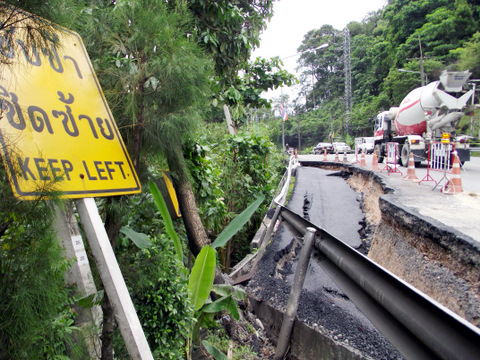
But if nature is sufficiently disturbed by human action, serious future devastation will happen sooner than later – like many of the landslides that have afflicted Phuket this year. Landslides are natural, but the timing of them can be advanced by human thoughtlessness.
Achieving balance in the island’s environment seems increasingly difficult. The clang of pile-drivers and the roar of giant trucks is heard everywhere, especially on slopes that have become targets for property developers.
“It’s as if development has slowly undermined this island,” says Phuket geologist Professor Amnart Tantitamsopon. And he warns, “If you just want to take from this island, later it will take back from you.”
Until recently most people on the island saw landslides as a remote possibility and not something to worry about.
However, for some people, ignorance has turned to fear during the past few weeks after landslides damaged their properties and in some cases caused injuries.
A community leader was buried in the wreckage of his own house when a neighbour’s wall collapsed in Baan Mon Community in Patong on October 3, while about 50 residents on bypass road were ordered to evacuate from the site following the landslide behind Adisak Equipment warehouse on October 5. The warehouse was hit by a massive volume of earth again on October 14.
In Rassada District the Natthakamol housing project was swept by a mudslide on October 11, after an illegal dam collapsed and sent water and mud pouring down the hillside.
Prof Amnart sees most of the recent landslides as being caused plainly by human activity such as random excavation, cutting, grading and constriction of natural waterways, any of which can result in instability in the soil and changes in water direction.
“Phuket has a specific geography,” Prof Amnart explains. “The island was heavily excavated during the tin-mining era. The existing geography was changed.”
As a result, many development projects today sit on heaps of crushed rocks and crumbly earth, the leavings of the earlier excavations. In some cases, a standard-length pile simply sinks right into the ground because the soil particles under the surface are loose, not hard-packed.
In this modern age there are various slope protection systems. So why do landslides seem to be occurring more frequently this year?
“The earth has been disturbed by careless grading and cutting,” the professor answers. Landslides, he says, are an indicator of how reckless humans are.
“The high price of land has resulted in the mainstream of Phuket development focusing on exploiting the potential profit to be made from the land, to a point that is much more than it should be.”
Many constructions have blocked natural waterways, and more and more buildings are being erected on slopes, Prof Amnart adds.
Another example of disaster caused by recklessness was the collapse of part of 50 Pi Road above Patong on August 25, on the same day that Patong was flooded by torrential rain. One house below was damaged.
Wattanasin Chaisawat, leader of the engineering section of Patong Municipality, says that road was built along slopes of more than 45 degrees from horizontal, without any slope protection system.
“We have found marks of unapproved excavations,” says Mr Wattanasin, “which have made things worse.”
The latest zoning and environmental protection regulations for Phuket, issued last year, allow a single house to be built on a slope as steep as 30 degrees.
Some restrictions apply, such as building height and percentage of landscape and open space, but Prof Amnart believes it is already risky to build a house on land that is more than 15 degrees from horizontal.
The regulations have a loophole: they state that building height is measured from the top of the roof down to the ground floor level of the building, rather than down to the original surface of the slope.
So people cut deep into the slope to create a flat area on which to build.
There is another clause that bars people from cutting down more than one metre from the surface of the slope, but this is widely flouted because there are no follow-up inspections by authorities.
More worrying, perhaps, there are no specific laws forbidding construction over a natural water course. Land owners are required only to discuss their plans with local authorities.
Once again, there are no follow-up checks – often because the local authorities lack qualified people to make judgements on the advisability of the owner’s plans, or the execution of those plans.
Lack of enforcement of the admittedly deficient laws is also a cause of slope damage, says Prof Amnart. “Without law enforcement to control earth grading and cutting, landslides will continue to occur.”
He and his team have spent years surveying Phuket’s geography thoroughly. They have found many places that have been illegally excavated. They have also found check dams – small dams designed to create a pool for irrigation, for example – in 30 landslide-risk places on the island.
The most high-risk spots are the hills around Patong, especially along 50 Pi Rd; the hillside along the bypass road and hills in the Kathu area. These are the areas where the greatest number of traces of illegal excavation have been found.
Usually, any kind of construction, excavation and check-dam building needs to be approved by local authorities, especially to ensure that planned excavation does not exceed specific depths and widths.
However, knowing that local authorities don’t check after giving permission, some people simply ignore the authorised plan and go ahead with illegal excavation.
“To protect this island, accelerated inspections and more rigid law enforcement are needed,” says Prof Amnart.
Phuket Governor Tri Augkaradacha thinks actions must go beyond that. He told members of the media on October 11, right after the mudslide swept through the Natthakamol housing project, that the pace of Phuket’s development should perhaps be slowed.
Since the beginning of this year, he said, 22 housing projects have been submitted for approval from the authorities. Four of those are on slopes.
“When one looks at real demand, Phuket will need fewer housing projects in the future,” the governor said.
The question is, how would one go about slowing development? As long as people continue to adhere to the profit principle – which means exploiting the land 100 per cent – it seems that Phuket’s environment will continue to degrade. And that means the number of disasters is likely to accelerate.
–Paritta Wangkiat