


Phuket is home to around 3,000 Thai-Nepalese, made up of three different groups – Myanmar-born Nepalese, Thai-born Nepalese, and immigrants who have arrived directly from Nepal.
Nepalese immigrants first settled in Thailand in 1953 on the Thai-Burmese border in Kanchanaburi province. Later generations formed small ethnic Nepalese communities across the Kingdom.
Phanupong Limbuprasertkul, President of the Thai-Nepalese Association (TNA) in Phuket, is a third-generation Thai-Nepalese who moved to Phuket around 25 years ago.
“We’re Thai,” said Mr Phanupong. “We were born and brought up in the ‘Land of Smiles’. But we are always conscious that our ancestors are Nepalese.”
Accordingly, they mostly speak both Thai and Nepali, plus English. In Phuket, Thai-Nepalese earn their living in a variety of industries, such as tailoring, hospitality, or selling T-shirts and souvenirs. As tourism offers them more opportunities, most live in Patong, Kata and Karon.
Mr Phanupong and Nepalese community leaders set up the official Thai-Nepalese Association six years ago. Committee members were elected through votes from the group’s members.
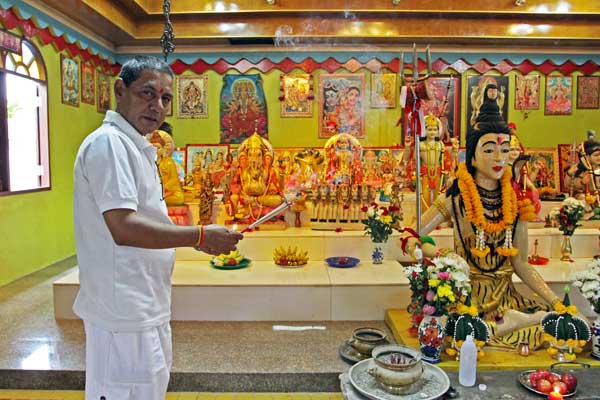
A religious shrine, with an attached association office, was built at Soi Kuan Yang on Patong Hill and has an outdoor gathering point.
The shrine has since become the heart of the community with wedding ceremonies, annual festivals and religious rituals held there regularly.
Most Thai-Nepalese people in Phuket worship a mixture of Hinduism, Brahmanism (a subgroup of Hinduism) and Buddhism, and celebrate both Thai and Nepalese festivals.
“Religion is the force that unites our community,” said association secretary Om Jee Khodomkul.
However, the association welcomes everyone from all nationalities and religions. As well as being a religious and cultural centre, the office acts as a community court where members can complain and settle their disputes. Problems range from personal and financial issues, family quarrels to crime.
Last May, Thai national Phakpoom Maneerat was arrested after he had allegedly raped a Nepalese woman.
With support from the TNA, six other Nepalese women came forward to report to police that they were also raped by the same man.
“Some members of our community are not treated well,” said Mr Phanupong. “But our social status today is better than it has been in the past.”
The NTA tries continually to improve social conditions for Nepalese.
Young Thai-born Nepalese, numbering around 30 per cent of the community, are encouraged to go to school and improve their language and other skills.
“We don’t want the tailoring trade to be the only option for the next generations,” said Mr Phanupong. “We want youngsters to have a proper education, so they can be something else such as lawyers or doctors.”
The Nepalese community is keen to raise its profile through social events, such as recently giving donations to flood victims. This was formally recognised by authorities two years ago when the charitable Sribakawat Sanatan Mandil foundation was set up by the Thai-Nepalese Association.
The lives of Phuket’s Nepalese are a constant balancing act between never forgetting their cultural heritage, while looking forward to their bright future as proud Thais.
–Paritta Wangkiat