


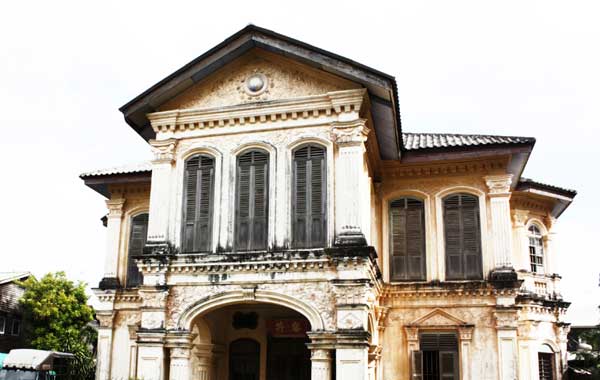
As I stare at the big pale yellow Thonthawes Mansion at the end of Deebuk Rd, it gives me a kind of a dim nostalgic feeling for something that existed before I was born.
Perhaps it’s because this is one of the best examples of Sino-colonial architecture on the island. Its proportion, its meticulous stucco, carving doors, and the reliefs on the walls have attracted uncountable pairs of eyes.
I used to think it was a dying house; its door was almost always shut tight.
But a couple of weeks ago when I stopped by the house, I learned for a very first time that the house was still alive, albeit breathing faintly.
Thonthawes Mansion has endured for almost 100 years. It was first owned by a respectable Chinese immigrant,
Tan Kuad, who climbed the social ladder by turning himself from a farmer into a wealthy figure in Phuket.
He left China when he was 23 years-old in search of a better life, and wound up in Phuket, finding opportunity in the island’s booming tin mining industry.
At the prime of his life, he was involved in variety of public works, and even helped to bring peace to Phuket, being involved in negotiations to resolve the Ang Yee conflict between tin mine owners and workers in the late 1870s.
Encouraged by performers in a touring Chinese opera troupe, Tan Kuad also established the beginnings of the vegetarian festival in Kathu. The annual festival is now a huge event in Phuket, attracting thousands of
participants, onlookers and tourists from abroad.
His decency caught the attention of King Rama VI of Thailand, who appointed Tan Kuad as Kathu headman, gave him the family name Thonthawes, and in 1913 conferred upon him the lordly title of Luang Amnartnararak.
Today, the Thonthawes Mansion, said to have cost the lordly sum of B30,000 to build (more than B10 million in today’s money), stands as a symbol of the wealth of an older generation, and as a display of past lives in Phuket.
Apart from elegant old furniture, old photographs and the house itself, built by Chinese artisans brought in from Penang, the mansion contains a priceless store of of memories and reflections of island society in the past.
Sitting on the front poach of the house, Aunt Bhee Nga, who’s about 70, speaks of her fading memories of the house that has been home to her for her entire life.
“It used to be fun here,” she says, “when all our families lived here together.” Aunt Bhee Nga explained that the interior of the house was divided into several rooms, each occupied by a family, all members of the same clan.
Luang Amnartnararak had seven children. The seven had expanded to dozens by the time Aunt Bhee Nga was born. At least 40 people lived in the house, she recalls. Indeed, a photograph dating back to 1927 (see top) shows 57 relatives, 23 of them children.
The door of the house used to be open day and night, welcoming neighbour and complete strangers alike to share the crowded interior.
Society today no longer suits that kind of life, she says. The house and the neighbourhood have changed.
As the Thonthawes Mansion grew older, family members split away to live as single families in other homes. Only four or five people live in the mansion today.
“I’m living in the same house as always – but it’s not quite the same,” Aunt Bhee Nga says, looking off into the distance.
It’s as if she woke up one day after decades of unbounded relationships, to find that neither she nor the house can trust strangers any more.
Today, the door of the house is shut.
Note: The mansion is not open to the public.
– Paritta Wangkiat