


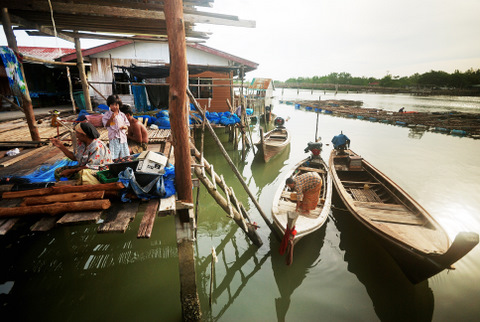
In Phang Nga province, an entire community built on stilts has emerged from the mangrove trees.
Bang Pat, situated an hour and a half north of Phuket, is connected to the mainland by a 300-metre-long bridge. Boats are a necessity, and a way of life for the community.
During low tide, fisherman walk on the mud flats between the stilt houses, and the mangrove trees look like they have been planted on land. When the tide comes up high, the stilts disappear, and the trees are back under the water of the Andaman Sea.
The community’s aim? Mangrove tree conservation. Every month a family plants another mangrove tree, ensuring the rejuvenation of the forest. The people here are mostly fisherman, and many are Muslim. They have hearts of gold and are more than happy to share their knowledge with fellow travellers.
The first time I arrived here and met the people of Bang Pat, we were immediately friends.
“Good morning, how are you kids?” they asked my friend and I. The kindness kept coming. “Tired? Have you eaten yet?” We hadn’t, but we were soon introduced to some delicious food.
The first man who discovered Bang Pat was Duan But-Laeb, from Krabi province. He came to the area temporarily for fishing in the early 1900s, but it wasn’t until 1953 that Phang Nga resident Masen Supparos settled in the village permanently, and many others soon followed because of the abundance of fish.
These days, there are about 80 families who live here, in the fishing village built on the water.
Bang Pat used to be called Baan Bang Ling, meaning monkey, because of the large number of them in the area. Now, people have replaced the monkeys, who scrambled off into the forest once development occured.
The name eventually changed to Bang Pat, which translates to “developed”. Because Bang Pat is far away from Phang Nga city, the community is largely left to their own devices without much help from the government, so must develop the area themselves.
There are 12 homestays here now to welcome visitors, but the Hutsanee family set up the first one many years ago.
Mhaad Hutsanee told me that one day a family arrived in the area at midday and the children were hungry. They asked his mother where they could buy food, or if there was a restaurant around, but there was nothing.
So his mother cooked fresh seafood for them for free, and then word of mouth spread about the beauty of Bang Pat. Soon, Mr Mhaad’s mother was running a business selling cheap food, and eventually he and his wife Aree Hutsanee decided to open a restaurant with a homestay, called Bang Pat Homestay.
The homestay is not just a restaurant or a place to sleep. Mr Mhaad provides many activities for visitors who want to learn about the Bang Pat way of life, including mangrove planting, fishing or cooking.
He said he wants visitors to know exactly how the people of Bang Pat live, how they work, and what it is like to be a part of the community.
After eating a big fresh seafood meal, Mr Mhaad took me on a boat trip to see the abundant mangrove forests around his home, and he let me plant a tree by myself.
While he taught me how to plant it, he had a warm smile and told me: “I’m quite afraid about becoming popular. I just want people to know about Bang Pat, and keep the area the same as we have it now. I want them to save our resources, especially the mangrove forest – to save it and not destroy it.”
I have found I have learnt so much from experiencing life like a Bang Pat local – living and doing activities like I live in the village myself. Mr Mhaad has reminded me there is a big difference between being a tourist, and being a traveller.
For more information about Bang Pat Homestay, tel: 086 274 4557 (Thai only) Getting there: Drive north on Highway 4 until you arrive at Baan Khao Thao. Turn right and follow the road for another 10 kilometres, until you find a concrete bridge that leads to the village.