


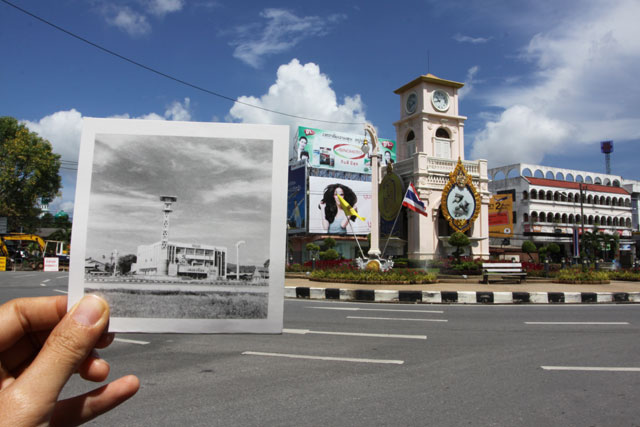
As the sun set, he would sit on a marble chair at the base of the clock tower, from where he gazed into the distant past, visualising how his hometown had looked many years ago.
Old Kim would sometimes pass on his stories and local knowledge to interested passersby, who inquired about the history of the famous landmark, and of Phuket’s past.
He would always begin by talking about his childhood growing up in Phuket in the early 1930s. He was one of many thousands of native-born ethnic Chinese, descendants of the immigrants who had come to Phuket to work in the tin mines and on rubber plantations.
Back then, Kim and his young relatives would sit on the green grass area at the circle to listen to older generations educate them about traditional Chinese literature.
All sorts of memories and thoughts were encapsulated at the Clock Tower Circle for Kim’s family – including their yearning for their home country and culture. However, their nostalgia was suppressed in 1938 when Field Marshal Plaek Phibunsongkhram became Prime Minister of Thailand.
A keen supporter of fascism and nationalism, he enforced anti-Chinese policies throughout the country to restrict the major roles of Chinese immigrants in the Thai economy at the time.
Mass media was manipulated, with flyers, newspapers and radio broadcasts used as tools to impose a nationalist Thai policy, as well as increase the pace of modernisation in the Kingdom.
The mandates included specific dress codes that all Thai citizens had to comply with, while national songs, and anti-communist and nationalist slogans were broadcast non-stop on the airwaves.
Field Marshal Plaek’s slogans such as “Hats will lead Thailand to great power”, or, “Follow the leader, and the nation will survive” were commonly heard.
Old Kim believed this was one of the reasons that the first radio tower was set up at Suriyadetch, or “fountain” circle near the Phuket Town Market in the early 1940s – to effectively communicate the Government’s messages. The Clock Tower located further south was built in the 1950s.
With its pre-modern Thai architecture, the Clock Tower had a slender shape and perforated structure, and had a design that attempted to replicate the shape of the Toa Sae Hill located behind it.
Some say that the origin of the Clock Tower was influenced by a second series of nationalist policies by Field Marshal Plaek in 1949, after the marshal returned to his leadership post one year earlier.
He ordered every provincial government office to set up radio broadcast devices in their areas, to play national songs, alert people to the time, and to announce government news. Some Phuketians say they’ve seen similar-designed clock towers in other provinces, which has led them to believe the Clock Tower in Phuket Town was a duplicate of others built around Thailand.
However, before Old Kim had the chance to investigate the tower’s true history, the structure was knocked down without warning by Phuket City Municipality on a quiet night on April 6, 2003.
The Municipality said it was time for Phuket to move forward with tourism, and the tower needed to be replaced as it was old and was at high risk of collapsing. Though many locals disagreed.
A new B7-million Clock Tower was built in its place, in a neo-colonial style to correlate with the architecture of Phuket Old Town. The same Clock Tower still stands.
Though the Municipality believed that modernising the Clock Tower would enhance Phuket’s tourism industry, many locals insisted the old Clock Tower was invaluable in term of memories and history.
Old Kim remembered many disappointed faces on the day the Clock Tower was no longer standing high in the centre of Phuket’s Old Town. It had become a landmark for the community.
The old man has not been seen at the circle for several years. It’s not certain if he has died, felt too upset over the loss of the old tower, or simply found another, quieter location to relax.
Though the new clock ticks on, for Old Kim, time stopped on the day the old one was knocked down.